
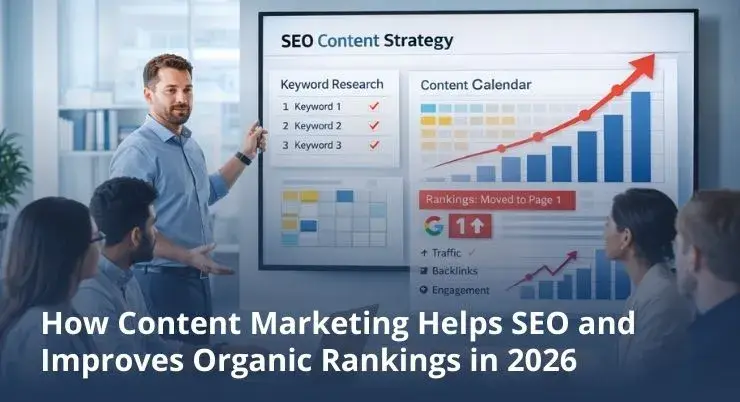
In 2026, SEO is not about stuffing keywords and hoping for the best. It is more like earning your place on page one. Content marketing helps you do that because it gives people real reasons to trust your website. When your content is clear, useful, and easy to read, people click, stay, and keep scrolling. That stay time, and engagement tell search engines your page is actually worth showing. Over time, that is what lifts your organic rankings and brings steady traffic.
Here’s the simple version of how it works. Search engines want to show results that solve a problem quickly. Content marketing helps you keep publishing those helpful answers, instead of posting random blogs with no purpose. When your page explains things properly, readers do not feel lost. They get what they came for, so they do not leave right away. That lowers bounce rates and builds trust.
And trust builds authority. If someone finds your content genuinely helpful, they might share it, reference it, or link to it. Those links and mentions make your site look more credible, which supports better rankings. When you keep doing this consistently, you also start showing up for more related searches. That is why content marketing and search engine optimization work best together in 2026, because one brings visibility and the other builds trust.
Why Content Marketing and SEO Work Better Together in 2026
Here is the simplest way to see it. SEO helps people find you. Content marketing helps them trust you. When both work together, you get visibility plus credibility. That combination is what improves organic rankings over time. Many marketers still treat these as separate tasks, and that split creates missed opportunities.
There is also a reality you cannot ignore. A large share of users do not go past page one of Google results. If you want consistent traffic, you need content that deserves page-one placement.
This is also why the importance of content in seo keeps increasing. Search engines need signals that a page is relevant and useful. Your content is what creates those signals. When the content matches the search, people stay longer, engage more, and often visit other pages. That behavior is a strong hint that you gave them what they came for.
How Content Marketing Improves Rankings and Increases Organic Traffic
When people ask how content marketing helps SEO, they often expect one magic hack. The truth is less exciting, but far more reliable. Content marketing improves SEO by making your website more useful. Useful sites earn more attention, more engagement, and more authority. Over time, those factors help you earn better positions.
Let’s start with quality. Search engines can tell when a page is thin or rushed. Readers can tell even faster. When you publish high-quality, informative content, it becomes more likely to get referenced by other websites. Those references often turn into links, and links are still a major authority signal. WebMavens also points out that quality content supports keyword use, click behavior, and backlinks.
Now let’s talk about engagement, because it is underrated. When your content is genuinely helpful, people scroll and read. They click into related posts. They come back later and search your brand again. These are the kinds of behaviors that strengthen your visibility and your overall brand presence. Slickplan describes this loop clearly because valuable content drives engagement and earns backlinks, which then support better rankings.
Freshness also matters, but not in a spammy way. You do not need to publish daily. You do need consistent content and occasional updates to your best pages. When you keep pages accurate and complete, you stay relevant for new searches. That helps you capture new long-tail queries and protect rankings you already have.
SEO-driven Content Marketing in Plain Language
A good seo content marketing strategy is not complicated. It is just intentional. You choose topics based on search demand and business value. You write pages that answer questions better than competitors. You connect related pages using internal links, so your site feels organized, not random.
This is what SEO-driven content marketing looks like in real life. You do not write a post and hope. You plan a topic, write the pillar page, and then publish supporting pages that target specific related searches. Those supporting posts do not compete with the pillar. They strengthen it.
This approach also helps you naturally integrate phrases without forcing them. You will still use content marketing keywords, but they appear because the topic demands them. You do not repeat a keyword like a robot. You mention it when it fits, then you move on.
Content Marketing and SEO: What to Publish in 2026
Here is where most brands get stuck. They write only informational blogs, then wonder why leads are slow. Or they write only sales pages, then wonder why traffic is low. The solution is balance. You need content across different stages, because people search differently based on where they are in the buying journey.
Informational content answers questions and builds trust. Commercial content helps people compare and choose. Transactional content makes it easy to take action. When you publish across these stages, you build a healthier traffic and conversion pipeline.
This is also where effective seo and content marketing become measurable. You are not only chasing impressions. You are building pages that attract visitors and move them toward decisions.
SEO Conversion Content: How to Turn Organic Traffic into Outcomes
Many businesses get organic traffic but feel disappointed with the results. That usually happens because the content answers “what is this,” but never helps the reader decide “what should I do next.” This is where seo conversion content matters.
SEO conversion content is still helpful and educational. It simply includes decision support. It reduces hesitation by explaining trade-offs. It adds proof and reassurance. It makes the next step feel obvious and low-risk.
In practice, this often means writing pages like comparisons, “best option” explainers, and case-based walkthroughs. These pages rank well because they match commercial intent, and they convert because they address buyer questions directly.
How to Structure SEO Content Strategies without Sounding Robotic
If your writing feels robotic, it usually comes from two things. You are trying too hard to “SEO write,” or you are overusing templates. A conversational blog sounds like you are explaining something to a colleague. That means you guide the reader from one idea to the next, and you answer the obvious follow-up question before they ask it.
Start with clarity. Use short paragraphs that feel natural on mobile. Keep each sentence under 20 words, but do not break lines after every sentence. Keep them in real paragraphs like normal writing. Avoid repeating the same sentence opener again and again. Those small changes make the content feel human.
Also, explain things with simple examples. For instance, if a page is about “content marketing & seo,” do not only define it. Show what it looks like. Mention how a guide can bring traffic for months. Mention how a comparison page can bring leads. Mention how a case study can earn links from other websites. That makes the point real.
Competitor guides also emphasize that combining content and SEO strengthens performance and visibility. They focus heavily on creating valuable, keyword-aligned content that supports user needs.
The Practical Checklist for What to Do after Keyword Research
You do not need a giant framework to move forward. You need a repeatable routine. First, group keywords by intent. Second, assign one main keyword to one page. Third, outline the page around what the reader expects. Fourth, publish with a clean structure using H2 and H3 headings. Fifth, link to related pages so the content supports each other. Finally, track what is getting impressions and improve those pages first.
This is the difference between “content production” and “content strategy.” Content production fills a calendar. A strategy builds a system that keeps improving.
How to Measure if Your Content Marketing is Improving SEO
Measurement is where most teams either overcomplicate things or ignore them completely. Keep it simple. You want to know if visibility is growing, and whether that visibility leads to meaningful outcomes.
Google Search Console is your best friend here. It shows which queries bring impressions and clicks. It also shows which pages are close to page one. Those “almost there” pages are the easiest wins, because small updates can lead to big gains.
You also want to look at engagement and conversion. If a page gets traffic but no action, it may match the wrong intent. Or it may need stronger internal links and clearer next steps. Fixing intent alignment is often faster than writing new content.
Common Mistakes that Hurt SEO and Content Marketing Integration
The most common mistake is writing content without knowing what the searcher wants. That leads to irrelevant content, higher bounce rates, and poor performance. Another common mistake is publishing thin posts that repeat what everyone else says. That does not create a reason to rank.
Some teams also ignore internal linking. They publish good posts, but every post stands alone. That weakens topical strength and wastes authority. Others avoid updating old content, even when it already gets impressions. Updating pages that already perform is often the fastest way to improve rankings.
FAQs
What is SEO content marketing?
SEO content marketing is creating content that ranks and helps readers at the same time. It blends helpful writing with search structure and optimization.
How is content marketing transforming the landscape of SEO?
It pushes SEO toward usefulness, authenticity, and stronger user experience signals. It also rewards brands that publish consistently and build trust.
Explain the connection between content marketing and SEO
Content marketing creates pages that answer questions and earn attention. SEO helps those pages get discovered through search engines.
Why is it important to create SEO-friendly content?
SEO-friendly content makes relevance clear to readers and crawlers. That improves visibility and supports better rankings over time.
How do SEO and content marketing complement and support each other?
SEO guides topic selection and structure based on demand. Content marketing builds authority, engagement, and long-term organic traffic.
Turn Keyword Research into Rankings with a Powerful Content System
If you are still asking what to do after keyword research, the answer is a clear content system. Build one strong pillar page for a main topic. Add supporting posts that answer specific related questions. Connect them through internal links, then keep improving based on Search Console data. This is how seo and content marketing integration turns into steady ranking gains.
Build Your 2026 SEO Content System with Pintox Digital
At Pintox Digital, we help you turn keyword research into a practical roadmap. We build a focused seo content marketing strategy that fits your goals and audience. We also create content that feels human, supports rankings, and drives action. If you want a repeatable 2026 system, we can build it with you.