
With so many ways to engage the audience, businesses in the digital world are forever on the hunt for new methods to generate leads and retain customers. However, one thing is bound to leave even the most experienced business owners and marketers perplexed – marketing automation vs email marketing.
Even though these two concepts are often used as synonyms, they perform entirely different functions. The knowledge of the key difference may prove useful to any business that aims at making its customer communication more effective and streamlining its growth process.
In this guide, we will walk you through marketing automation and email marketing, explaining the difference, mechanisms, overlapping areas, and the most suitable option for your business.
What Is Email Marketing?
Email marketing is one of the oldest and most successful forms of online marketing that exists today. Email marketing is the process of sending emails to your leads, prospects, or customers to spread useful information and increase sales.
The common uses of email marketing campaigns include:
- Sending out newsletters
- Offering promotions
- Informing about new products/services
- Sharing company news
- Educating customers
- Reaching out to dormant users
Email marketing is all about communicating through one channel – email. The main purpose of email marketing is to inform people and to make them take some specific actions, like buying something, scheduling an appointment, or just visiting your website.
Today’s email marketing systems are far more developed than they used to be. One can design targeted email campaigns and track their success with conversion tracking and campaign analysis tools. However, it is still only one part of customer communications.
What Is Marketing Automation?
To understand the difference between marketing automation vs email marketing, it is imperative to first have an understanding of what marketing automation entails.
Marketing automation involves the use of technology for automating marketing functions on several channels and at several customer interaction touchpoints. Instead of manually sending out communications or monitoring customers’ actions, a business uses marketing automation software for managing all interactions automatically.
Some of the things involved in an effective marketing automation plan may include:
- Email communication
- SMS marketing
- Automation of lead nurturing
- Automation of customer journeys
- Social media interaction
- Automated follow-up for customers
- CRM updates
- Lead scoring
- Notifications to sales team members
- Customer retention initiatives
- Artificial intelligence-based communication
Instead of being focused only on sending out communication, marketing automation plans aim at guiding the customer along his/her journey through the entire customer life cycle.
Marketing Automation vs Email Marketing: The Core Difference
One simple difference between marketing automation vs email marketing is that:
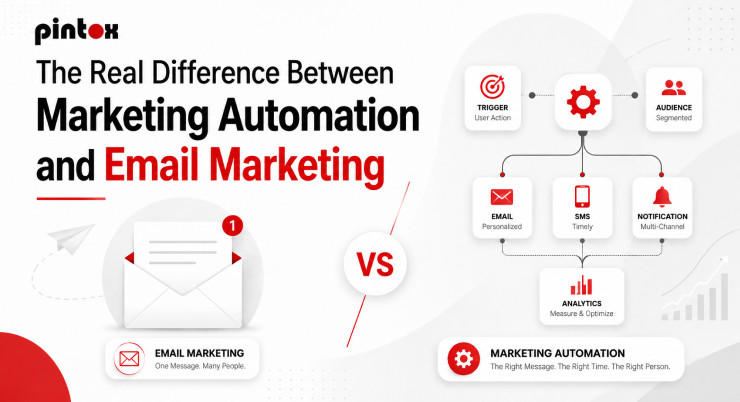
Email marketing is a communication medium.
Marketing automation is a process that manages customer engagement in multiple communication mediums.
Email marketing communicates.
Marketing automation determines when and how to communicate based on customer engagement.
For example, the business can distribute a newsletter via email marketing on a monthly basis. However, using marketing automation, the business can communicate with customers based on their actions, such as sending them an email if they download a guide, following it up with a text if they do not respond, alerting the sales representative about increased engagement, and continuing to nurture the lead using automated processes.
In other words, email marketing is an element of the overall marketing automation process.
How Email Marketing Works
Email marketing campaigns traditionally are based on scheduling. Companies develop an email message, choose recipients, and distribute it.
Some services provide automatic email marketing features like:
- Welcome emails
- Birthday emails
- Promotional series
- Drip email campaigns
- Onboarding series
- Abandoned shopping cart emails
Such email processes make campaigns more efficient and engaging but they stay focused on email only. The most advanced email sequences are still concentrated on communicating with customers.
How Marketing Automation Works
Marketing automation is not limited to emails. Rather than just sending out messages, it reacts to customers’ activities in real-time.
Here is how that works:
A customer downloads an e-guide from your website.
The system then performs the following actions automatically:
- The contact is added to the CRM
- The system assigns lead scores
- It sends out a personalized email
- Follow-ups are scheduled automatically
- It sends out a text message reminder
- If there is an increase in engagement, it notifies the sales team
- The system moves the lead through pre-designed marketing workflows
All of these actions are performed through workflow automation and behavioral triggers.
The Role of Customer Data
A key point that differentiates marketing automation from email marketing is the utilization of customer data. The contact details and basic activity information, like the number of times they open or click on an email, are stored in the email marketing systems. In contrast, marketing automation tools go beyond these.
They monitor:
- Number of website visits
- Forms filled in by customers
- Purchasing pattern
- Activity with content
- Communication patterns
- Preference settings
- Sales interactions
Through customer segmentation and customer lifecycle marketing, organizations are able to give a very personalized experience to every individual prospect.
CRM and Marketing Automation: Why Integration Matters
Modern organizations accumulate a lot of data about their clients. The processing of such data manually will be too difficult. Here is when the cooperation of CRM and marketing automation comes into play.
CRM accumulates all client data, as well as sales activities and histories of interactions. Marketing automation makes use of it in order to make appropriate messages automated.
With the help of CRM integration, the organization receives an opportunity to see the whole picture concerning every customer and to start automatic actions when necessary.
For instance, if the client asks for a price list, then the software will automatically start the appropriate communication sequence for him/her.
Which Approach Generates Better Results?
In comparing marketing automation vs. email marketing, many business owners are curious about which one will deliver better results. It depends on what you want to achieve.
Email marketing can be very successful in the case of:
- Newsletters
- Product announcement
- Promotion campaigns
- Customer notifications
- Education
Email marketing alone will work well for those businesses whose communication needs are not complex. Marketing automation strategies make sense for those companies that require:
- Automated lead acquisition
- Automation of customer journeys
- Automation of sales funnels
- Multi-channel marketing
- Personalized customer experience
- Lead nurturing
- Communication system automation
As businesses evolve, managing all these things manually becomes harder and harder. Automation brings order to all these processes.
Marketing Automation for Small Business
Automation is often seen as something that only big companies have. On the contrary, marketing automation for small businesses has many benefits.
Smaller companies lack resources and have little time to do things. It becomes easier because of automation, which can manage recurring tasks.
They include:
- Appointment reminders
- Lead qualification
- Follow-up messages
- Customer onboarding
- Customer engagement automation
- Requesting reviews
This way, businesses can spend more time working with their clients.
The Rise of AI Marketing Automation
There is constant advancement in technology, and one such big advance is the automation of marketing through artificial intelligence.
Artificial intelligence can examine customer actions and intentions and communicate in an individualized way. It does not depend only on rules but rather learns from customers and improves its performance constantly.
Thus, through AI marketing automation, we can achieve the following:
- Improved personalization in messages
- Higher conversion rates of leads
- Better customer channels of communication
- Campaign management optimization
- Improvement in customer retention strategy
As the capabilities of AI keep developing further, marketing automation is becoming more intelligent.
Common Misconceptions About Marketing Automation vs Email Marketing
Many common myths usually mislead people. Which includes:
Myth 1: Marketing Automation Is Limited to Automated E-mails
Though e-mail marketing is significant, it includes not only e-mail marketing but also many other means of communication, customer tracking, and business processes automation.
Myth 2: E-mail Marketing Is Outdated
E-mail marketing is one of the most effective digital marketing channels. The main thing here is to use it strategically in your customer relationship management.
Myth 3: Automation Excludes Personalization
On the contrary, automation sometimes leads to the improvement of personalization of marketing communications.
Myth 4: Automation Is Designed Only for Big Businesses
The modern market of marketing automation software includes solutions for companies of any size and budget.
Choosing the Right Solution
The choice of marketing automation versus email marketing must depend on what works best for your company. If you are required to send emails such as newsletters and promotional emails, email marketing campaigns could be a good option for you.
However, if you need to handle leads, automate processes for customers, and enhance pipeline automation in sales and communication in general, marketing automation would be a more holistic approach.
Many companies come to realize over time that a combination of both is the way to go.
Frequently Asked Questions
Q: Are email marketing and marketing automation the same thing?
Ans: Not at all. Marketing automation is concerned with the overall journey of the customer in different media, while email marketing deals with email correspondence.
Q: Does email marketing need marketing automation to function?
Ans: No, email marketing can exist independently of marketing automation.
Q: What are examples of marketing automation?
Ans: Examples include lead nurturing automation workflows, appointment reminders, CRM updates, AI chatbots, customer onboarding sequences, and automated follow-ups.
Q: Is marketing automation worth it for small businesses?
Ans: Yes, marketing automation will help small businesses save time, increase the speed of response from leads, and improve conversion rate even without new employees.
Q: What is the biggest benefit of marketing automation?
Ans: The main advantage is the timely delivery of the appropriate message to the proper recipient.
Q: Is marketing automation an alternative to email marketing?
Ans: No. Email marketing may be part of marketing automation in many cases.
Q: How can CRM help to advance marketing automation?
Ans: It makes it possible to trace customer activities and generate individual messages automatically.
Final Thoughts
Learning about the difference between marketing automation vs email marketing is critical for any business seeking to increase its efficiency, improve its customer relations, and scale up.
Email marketing is a technique used to send messages via just one medium. In turn, marketing automation is responsible for managing the whole process of customers’ interaction by putting together communication, data, and decision-making.
Both concepts have their place in contemporary marketing. Nevertheless, those companies that need scalable development, more insights on their customers, and effective operations should consider marketing automation, which involves much more than email marketing only.
When customer demands change all the time, businesses that choose automation, personalization, and customer engagement will have competitive advantages over others.