A potential client does not need to enter several keywords into Google, visit ten sites, and make a comparison of their own.
Instead, they can ask a much more precise question to ChatGPT, Perplexity, or another similar service and receive a summary answer with references. That makes visibility for your business different.
While your website ranks high in traditional search, the brand itself almost never pops up when someone uses an AI-powered service to request advice, comparison, and solutions from your industry. It is where the debate about GEO vs SEO becomes relevant.
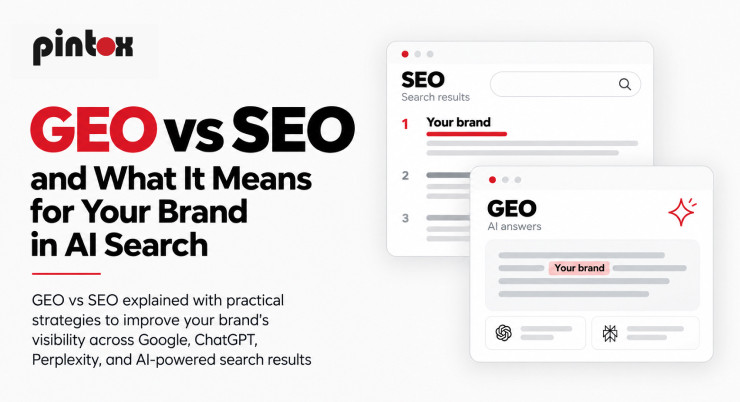
GEO (generative engine optimization) refers to efforts made to improve the odds of AI-powered search services recognizing, referencing, and citing your brand and content. SEO (search engine optimization) refers to efforts to help search engines index, recognize, and rank your website.
The two approaches are quite similar. Actually, Google itself says that the same SEO best practices are the foundation of ranking in AI Overviews and AI Mode.
The goal is not to drop SEO and move to a totally different optimization approach. It is to create a website that would work with both of the approaches.
What Is GEO and How Is It Different From Traditional SEO?
Generative Engine Optimization (GEO) is a phrase used to describe attempts to make a brand visible in generative AI search experiences.
In other words, GEO is not focused on how visible you are in terms of being a blue link, but rather, how the AI system understands your business, recognizes your expertise, finds value in your content, and possibly even mentions your website in its answer.
On the other hand, traditional SEO is focused on search engine visibility by addressing such fields as:
- Search intent and keywords targeting
- Indexation and crawling
- Website’s technical health
- Quality of the content
- Internal links
- Page experience
- Authority and references
- Structured data
A great deal of intersection exists between these two concepts. This becomes very clear through the latest recommendations from Google. In Google’s vision, AEO and GEO are industry terms for optimization of AI search visibility, but according to Google, optimizing for generative AI search is part of SEO.
That means that businesses do not have to have two completely different websites/content strategies.
Traditional SEO vs GEO at a glance:
| Traditional SEO | GEO |
| Focuses heavily on search rankings and organic visibility | Focuses on visibility within AI-generated answers |
| Targets searches and search intent | Targets questions, topics, entities, and conversational queries |
| Optimizes pages for search engines and users | Helps AI systems understand and use the information |
| Measures rankings, impressions, clicks, and conversions | Can also monitor brand mentions, citations, and AI visibility |
| Relies on strong technical and content foundations | Builds on those same foundations |
The distinction is useful, but it should not be treated as a hard divide.
How ChatGPT and Perplexity Search Differ From Traditional Search
Typical search offers users some results to look through. AI search can offer an interpretation of the question, gathering the necessary information, synthesizing the sources, and giving an answer.
For instance, ChatGPT Search can do a search of up-to-date information from the web and offer links to relevant sources. According to the OpenAI description, ChatGPT Search can leverage search providers and partner content in order to find necessary information.
Perplexity also claims to be working by retrieving information from the web, synthesizing various sources, and citing them along with the answer. The current documentation on Pro Search mentions the ability of the system to perform various searches and analyze the information from various sources.
It results in a different visibility problem for the business:
Can the AI system get enough reliable information about my industry and cite my brand?
It is a different question from ‘What position does my page have for this keyword?’.
Why Traditional SEO Still Matters for AI Search
The easy assumption here could be that GEO implies a whole new strategy from scratch. In most cases, this would be incorrect.
As per the current documentation on Google, pages appearing in the AI Overviews and AI Mode must be indexed and searchable on the regular Google Search platform. Google also advises on using the standard SEO principles of permitting crawling, using internal linking, using text to provide necessary information, having good page experience, and using consistent structured data with what’s shown on the page.
In simple terms, technical SEO remains relevant.
If search engines are unable to discover and understand your website, then a couple of AI-specific keywords will not help you fix the problem.
The following should remain at the core of your strategy:
- A crawlable website
- Logical site architecture
- Proper page titles and headings
- Good internal linking
- Great service/product pages
- Quality content
- Detailed business information
- Page experience
- Necessary authority and mentions
GEO is an add-on for all these things.
How to Improve Your Brand’s AI Search Visibility
It is impossible to come up with a definite plan on how to get a mention of your brand in ChatGPT or Perplexity. Nevertheless, there is something you can do to make your business more comprehensible and understandable for a search engine.
1. Make sure that information about your business is crystal clear
The AI needs to know what your business does.
It should be clearly said on your website what is:
- Offered by your company
- The target audience of your company
- The geographical location of your company
- The industries or types of clients your company specializes in
- Your uniqueness
- How to reach your company
Do not use overly vague phrases that sound good and impressive but tell nothing.
Instead of:
‘We offer innovative digital solutions for modern businesses.’
Tell the truth.
2. Write content that answers real questions
The AI search users usually ask full questions and not just keyword phrases.
A small service business owner could be looking for:
- What is the best CRM for a small service business?
- How can an agency automate lead follow-ups?
- What do I need from a local SEO agency?
- What does a typical website SEO involve?
- What marketing services does a growing local business require?
Your content needs to answer these questions. However, it does not mean writing hundreds of web pages covering all possible queries. Google explicitly states that it is not a good idea to produce such large amounts of content that are meant to manipulate AI answer ranking and search results.
Instead, create something helpful regarding those questions.
3. Display first-hand experience
Generic material can be easily duplicated. First-hand experience is not so easily replaced.
If you have been involved with certain project types in your business, then discuss what you have learned. Use specific examples, processes, observations, data, screenshots, original research, and/or case studies where relevant.
The most recent Google guidelines for generative AI explicitly point to unique and valuable content as commodity-free material, and highlight first-hand experience as one of the means to supply such material.
For example, an agency can release:
- The actual campaign analysis
- A workflow automation case study
- Performance metrics before and after
- An example of an SEO audit
- Lessons learned from an unsuccessful campaign
- Explanation of how something works
4. Create topical depth rather than standalone blog articles
One article does not usually provide a full degree of expertise in a topic. Let’s take an example where you provide SEO services for your business.
Your new content architecture may feature a main SEO guide based on articles related to:
- Keyword research
- On-page SEO
- Technical SEO
- Local SEO
- Linking (internal)
- Optimization of Google Business Profile
- SEO Reporting
- Search Visibility with AI
All of these articles can be linked with each other using internal links.
This kind of interconnected content will allow visitors to jump from one useful article to another and give search engines better knowledge about topics covered by your website.
5. Make sure your brand is visible online outside of your website
AI programs don’t always perceive a company from a single web page. Your business could be mentioned in industry articles, directories, reviews, partner sites, interviews, social media profiles, and other reliable sources.
It is essential to have brand consistency then. Your company name, services, location, expertise, and other critical information about your company must be accurate everywhere you appear to customers or third parties. This strategy is especially effective in local markets where businesses compete.
6. Make it easy to verify critical information
AI-generated answers typically come with citations allowing users to dig deeper into the sources. According to OpenAI, ChatGPT Search allows people to follow the link to the sources, whereas Perplexity highlights that citations let users double-check the information provided.
It is crucial for your website to provide access to the critical information without hiding it behind a complicated navigation system or images.
Your site must contain the following information in the form of clear text:
- Services
- Price information if needed
- Locations
- Product specifications
- Policies
- Credentials
- Case studies
- FAQ section
- Contacts
GEO Strategies That Work With Your Existing SEO
It is not necessary to make an ‘AI version’ of each and every page you have. Instead, think of reviewing your current SEO strategy from a wider perspective.
Write for the question, not only the keyword
The keyword ‘digital marketing services’ may reflect several queries at once.
Extend the subject and answer the questions related to it.
- What services are offered?
- For whom are these needed?
- What can be expected?
- How are the prices?
- What are the implementation periods?
- What will be the results?
Thus, the material becomes valuable both for those who come through Google and other search engines and for ChatGPT or Perplexity users.
Structure your content clearly
Both AI and human readers find organized content easier to understand. Use descriptive headings, short paragraphs, tables if applicable, examples, lists, and direct responses.
Do not fill every section with key terms and phrases. Make sure every section is answering a question.
Ensure that all business data is updated
Stale content can cause issues for both users and search algorithms.
Check the following:
- Description of services provided
- Location details
- Contact details
- Opening hours
- Staff details
- Price references
- Product information
- Case studies
- Statistics
Google suggests updating all relevant Business Profile data when optimizing for AI features.
Common GEO Mistakes to Avoid
Considering GEO as an alternative for SEO
SEO and GEO are not two alternative marketing channels, in which case one would have to replace the other. Specifically, regarding Google, SEO continues to be fundamental for generative AI search engines.
Producing lots of generic AI content
More content does not equate to increased visibility. According to Google’s recommendations, the emphasis should be on valuable, unique content without producing a large number of pages solely to impact rankings and AI responses.
Attempting to obtain a guaranteed position with ChatGPT
No formula can be found that guarantees a ranking in ChatGPT and Perplexity similar to the one in the traditional keyword ranking. The AI response depends on the question itself, sources found, models used, and context.
Try to become a reliable and understandable source instead of forcing the AI to give a particular answer.
Disregarding the technical aspects of SEO
A beautifully written article will not make up for the poor accessibility of a website by search systems. Technical accessibility still belongs to the foundation.
How to Measure AI Search Visibility
Measurement is an ongoing process. SEO measurement standards such as organic impressions, clicks, rankings, conversions, and assisted conversions are valid.
Businesses can also measure:
- Mentions of the brand in answers generated by AI
- Mentions of their website
- Pages mentioned in those mentions
- Questions where competitors show up instead
- Traffic referred from AI services
- Leads or conversions from AI services
- Increase in branded search demand
An individual response from AI technology is not a complete ranking report. Search engines and AI may come up with different answers for the same query depending on the situation. OpenAI’s own documentation indicates that citations and search results can sometimes be out-of-date, incomplete, or even wrong.
The Practical Future of SEO
It needn’t be one or the other – there doesn’t have to be a decision between SEO search and AI-based search. Humans use multiple methods of discovering information online. Some want a directory of websites to choose from. Others want the answer right away. People will likely use both options depending on their current needs.
This translates into business requirements for SEO being relatively straightforward:
‘Make me discoverable, understandable, and trustworthy’
SEO makes the website easy for search engines to detect and evaluate. Good quality content provides relevant data for AI algorithms to process. Good branding and expert status provide motivation to trust what is found.
This is a much more sustainable approach to GEO vs SEO than searching for shortcuts or secret AI optimization tricks.
Frequently Asked Questions
Is GEO replacing traditional SEO?
No. Although GEO is often used to refer to optimization of generative AI search experiences, the actual methods used have much in common with SEO. Google itself says that the best SEO practices currently being followed apply equally to its AI search capabilities.
What does GEO mean in marketing?
GEO means Generative Engine Optimization. It involves methods aimed at improving a brand’s presence, visibility, representation, and citation in the context of generative AI search experiences.
How do I rank on ChatGPT?
There is no guaranteed ranking formula for ChatGPT. However, one could use the tried-and-tested SEO principles of creating good content, having correct data about their businesses available online, ensuring technical accessibility of their websites, and creating reliable citations all over the internet. ChatGPT Search uses web resources to provide answers.
What is the difference between AEO and GEO?
The terms AEO and GEO typically refer to Answer Engine Optimization and Generative Engine Optimization respectively. Both terms may be applied to efforts that have something in common and that aim to improve a company’s visibility in answer and search experiences driven by AI. These tasks are integrated into Google’s search optimization strategy.
Does Perplexity use web content on websites?
Perplexity AI searches the internet and compiles information from various sources. Its documentation indicates that the search experiences provided by Perplexity include citation of the sources from which it obtains its information.
Do I need any particular schema or AI-specific file for GEO?
Not for the Google AI Overviews or AI Mode. According to Google’s guidelines at present, there are no technical requirements beyond the standard Search ones for those two particular AI tools.
Should businesses separately focus on GEO and SEO?
It may be more feasible to first improve the common ground – accessible technical pages, useful content, site structure, information about the business, internal links, and credibility. From there, businesses can examine their presence in both conventional and AI search experiences.
Conclusion
The debate around GEO vs SEO can lead you to believe that AI search is a completely different marketing field. This is not quite true. There are many similarities between the two.
First of all, your website should still be easy to find. It must provide answers to user queries. Your business information should still be accurate. Your pages should still offer value to users.
The difference lies in the fact that users want search engines to perform more work for them when it comes to summarizing and researching information. In this respect, content becomes even more important.
Instead of rejecting classic SEO techniques, you should improve upon them. Create authoritative content, organize it properly, enhance your brand image through credible channels, and track whether or not your visibility increases in the search environments your clients use.