Any company aims to boost its visibility, attract more clients, and generate sales. However, it can be hard to choose where to allocate marketing budget funds. There are two highly effective methods for increasing website traffic by attracting clients online – pay-per-click advertising (PPC) and search engine optimization (SEO).
This is exactly why the PPC vs SEO discussion stays relevant and one of the most popular questions for business owners and marketers who try to promote their services and products and make sure that they attract more clients through websites and social media pages.
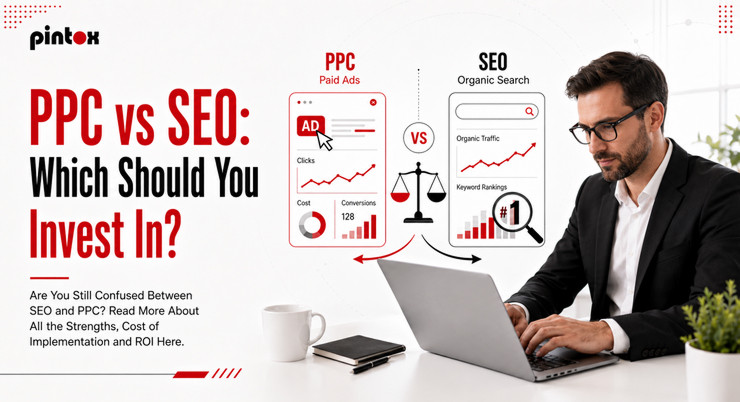
It is important to note that there is no universally true answer, as each method is good for certain purposes. It is also important to understand what kind of results a company needs right now and in the future. That is why in this article, we will discuss SEO vs PPC and show the difference between them and how these strategies work.
If you are not sure what is better, PPC or SEO marketing, keep reading this article.
What Is the Difference Between PPC and SEO?
Before discussing the PPC vs SEO comparison, it’s necessary to consider how both methods can attract visitors to your website.
What Is SEO?
SEO stands for search engine optimization – the process of optimization that makes it possible to improve the visibility of your website in the organic search results. Unlike PPC, you don’t have to pay each time someone visits your website.
The SEO technique includes the improvement of your site’s relevance and authority through the use of good content, keyword research, Technical SEO, website changes, and an effective SEO marketing strategy.
It allows search engines to learn more about your website and provide useful information for users. As a result, search engine rankings, organic traffic, and leads increase.
For instance, when people search for “best plumber near me” phrase, those companies with an effective Local SEO Strategy will appear on the top positions in organic search results without paying for each click.
What Is PPC?
Pay Per Click advertising gives firms the opportunity to place their advertisements on top of search engine results. Each time an individual clicks on your advertisement, he pays some money for the click.
Google Adwords is the most prevalent form of PPC advertising. In this type of advertising, the advertiser bids on certain keywords related to his business.
The difference between PPC and SEO is that visibility is immediate in PPC, meaning that your advertisement starts pulling traffic into your site as soon as the campaign kicks off.
The success of a PPC campaign requires:
- Choosing appropriate keywords
- Handling keyword bidding
- Cost per click (CPC) monitoring
- Improving the CTR of your advertisement
- Optimizing your ad copy
- Landing page optimization
- Determining the conversion rate
The performance of your campaigns determines the efficiency of your lead generation.
PPC vs SEO: A Quick Comparison
In terms of comparing PPC to SEO, most individuals consider one of them to be definitely superior to the other. In actual fact, both approaches address completely different business challenges.
| SEO | PPC |
| Gains organic traffic | Gains paid traffic |
| The results come progressively | The results come instantly |
| Doesn’t pay per click | Pays for each click |
| Good SEO strategy in the long run | Great for quick promotions |
| Keeps bringing traffic forever | The traffic stops once the ads stop |
In addition, this table illustrates why there is a heated debate about paid search vs organic search.
How SEO Helps Businesses Grow
One of the greatest things about SEO is that it keeps doing its job even long after you publish your content.
Proper search marketing campaign includes such important aspects as producing valuable content, optimizing a business website, and gaining trust from both users and search engines.
The major SEO benefits include:
1. Sustainable Organic Traffic
Unlike PPC campaigns that make you pay per visitor, SEO will bring visitors to your website naturally through the search engines.
The more you rank, the more sustainable traffic your site will have.
2. Higher Brand Credibility
Many users tend to trust those websites which appear in the organic results and not advertisements.
Being able to rank highly for competitive keywords means that you increase brand visibility and gain authority in your industry.
3. Higher Long-Term ROI
Though it takes some time to implement SEO, the results it produces are great because once your content becomes useful for the visitors, they keep visiting your site for many months or even years.
Single high-quality piece of content might attract thousands of visitors without any additional spending on the promotion.
4. More Customer Satisfaction
Not all that is involved in SEO is keyword analysis.
The new optimization process involves:
- Page speed improvements
- A mobile responsive design
- Improved website navigation
- Website optimization
- Content
- Calls to action
These will help visitors locate what they need easily, resulting in more engagement and conversion.
5. Provides Help through the Entire Funnel Process
Customers receive support from SEO at every stage of the funnel.
Someone searching for content related to education may come across your site when they have not made up their mind about making a purchase. Your content helps build their confidence until they decide to become a customer.
Thus, SEO is a great lead generation strategy.
How PPC Delivers Faster Results
Whereas SEO is a strategy that requires patience, PPC emphasizes speed.
In cases where you require leads within a week rather than half a year, PPC advertising could be more suitable.
Your advertisement will show up before those who have an interest in what you have to offer.
Instant Exposure
Instant visibility is one of the key advantages offered by PPC.
Rather than waiting to get better in terms of rankings, you can be displayed at the top of Google within hours.
Some of the instances when PPC could be helpful include:
- Business launch
- Seasonal campaigns
- Time-sensitive offers
- Launch of a product
- Competitive industry
- Target Audience
Modern campaigns for Google Ads enable advertisers to target people by:
- Location
- Devices
- Intent of search
- Demographics
- Interests
- Time of the day
Such targeting improves lead quality while cutting down wasted spending on ads.
Tracking Easy Performance
Unlike many other traditional advertising platforms, PPC enables detailed tracking of performance data.
Companies can track the following aspects:
- Clicks
- Impressions
- Conversion rate
- Cost per acquisition
- ROI tracking
- Performance of the campaign
That makes it easier to enhance marketing performance.
More Precise Budget Control
One of the misconceptions related to PPC is that it always demands a large budget.
In reality, companies can control their daily budgets and even change them anytime needed.
Still, the costs of PPC advertising differ greatly across industries and depend on the competitive environment and keywords’ intent. Competing industries usually feature high CPCs.
SEO vs Google Ads: Which One Delivers Better Value?
The SEO vs Google Ads discussion is always about time vs sustainability.
Google Ads allows you to reach your audience right away but needs continuous spending. SEO takes time but keeps paying back even after you’ve completed all the necessary work.
When it comes to companies planning steady growth in the future, SEO turns out to be the better digital marketing strategy choice. Meanwhile, companies who require leads immediately or offer something time-limited may prefer PPC.
Instead of seeing Google Ads vs SEO as rivals, the most successful companies often combine them into one strategy. When PPC gives quick results, SEO creates a base to cut costs on advertising in the future.
In the following section, we will talk about PPC or SEO for small business, SEO vs PPC ROI, the cases when you should use PPC, the cases when SEO is better to choose and explain why the combination of both SEO and PPC gives the best result.
PPC or SEO for Small Business: Which Is the Better Investment?
For most entrepreneurs, the issue is not whether SEO or PPC works but whether they can afford both.
Asking “PPC or SEO for small business?” will depend on your current business stage.
While a newly launched company that has low online presence may resort to PPC for gaining inquiries while constructing its SEO structure, an already running business with stable financial resources will opt for SEO as it brings results over time.
Rather than thinking about which is a better approach, consider the following questions:
“Do I require immediate inquiries?”
“Am I constructing my brand in the long run?”
“How competitive is my business?”
“What is my marketing budget?”
In most cases, the answers will show you which direction to go.
When Should Businesses Use PPC?
The primary benefit of PPC is speed. For instance, in case your business needs visibility now, paid advertising will allow you to get noticed by potential customers quickly.
Thus, in what cases should businesses use PPC?
Starting a New Business
A fresh website is not authoritative enough to rank at the top of search engines. PPC will enable new businesses to start drawing customers while SEO will be developing its full potential.
Running a Time-Limited Promotion
It won’t be reasonable to wait for several months before achieving high ranking when your business has something special going on now.
Entering Competitive Industries
There are some sectors that are very competitive, meaning it would be difficult for businesses to get high ranking in the short run. Properly managed Google Ads campaigns will help businesses to compete now, even compared to their larger rivals.
Market Testing
Finally, PPC is good for experimenting with various kinds of products and markets, and collecting the information on customers’ behavior, search intent, and successful keywords.
When Should Businesses Invest in SEO?
In case you seek sustainable growth, then SEO should be one of the essential elements of your marketing strategy.
Then, when should companies invest in SEO?
The solution is obvious: as soon as possible.
SEO is a long-lasting process but each progress step you will take today will continue bringing more value tomorrow.
The following goals require SEO efforts from the company:
- Increasing organic traffic
- Improving search engine rankings
- Building authority
- Reducing customer acquisition costs
- Generating leads constantly
- Cutting down paid advertising expenses
Long-term SEO strategy will help you improve all aspects of your website from content quality to user experience and business website optimization.
SEO vs PPC for Local Businesses
Local companies frequently question whether they need to concentrate on local SEO or Google Ads.
Whether they need one or another depends on the target audience they intend to capture.
When people urgently need an emergency electrician, plumber or locksmith, then Google Ads will be beneficial since the user is ready to make a decision instantly.
Nevertheless, those who keep investing in local SEO eventually take the lion’s share of organic search results since they show up whenever anyone looks for local services, receive more reviews and build trust within the community.
Therefore, for most companies that offer local services, the best SEO vs PPC strategy would be using both methods at once.
Which Is More Cost Effective: SEO or PPC?
Another popular query is: “Which one is more cost effective SEO or PPC?”
PPC involves constant expenses, and once the budget for ads runs out, there will be no more ads and no more traffic.
SEO also involves making initial investments in content creation, SEO audit, Content Marketing and technical SEO, but after your pages become ranked, you won’t have to pay for each visitor individually anymore.
Compared to PPC vs SEO ROI, the latter proves to be more profitable since every piece of SEO-optimized content becomes your property.
This, of course, does not make PPC less valuable, as for companies that depend on instant income generation, fast profits are worth their money.
Everything still depends on your intentions rather than financial aspects.
Can SEO and PPC Work Together?
Absolutely.
One of the largest blunders that most businesses make regarding SEO and PPC is that they treat them as competing methods when in reality, they complement each other.
So when asking yourself, “Are SEO and PPC compatible?”, the answer would be a resounding yes, as most successful businesses utilize them.
Some examples of this are:
- PPC brings instant traffic, and SEO brings in long term traffic
- PPC gives the business insight into what keywords to use for future SEO content
- It makes the business more trustworthy since it shows up in both paid and organic results.
- SEO content assists in remarketing by drawing in new traffic which can be utilized for advertising.
The usage of both makes an even more robust search marketing campaign.
Mistakes That Businesses Make
Selecting PPC vs SEO is just one problem. There are plenty of ways to cut down on your results by committing to certain mistakes.
Counting on Quick Results from SEO
SEO cannot help you right away. It needs patience and time to increase your ranking.
Running PPC Campaigns Without Any Optimization
Just putting up advertisements is not enough. Unless you optimize your landing pages and create a good ad copy, businesses waste their advertising money.
Ignoring Search Intent
Getting the wrong keyword ranking or buying irrelevant clicks does not mean getting conversions. Understanding the search intent is crucial for SEO and PPC.
Thinking That All the Traffic Is Good
A lot of traffic is not always good.
Your aim is to get people to your website who are really interested in what you offer and guide them through your sales funnel.
Not Thinking about Your Website Quality
Whatever method you use to attract traffic, people will leave if your website is slow and messy.
Good websites have an easy-to-navigate structure and quality content and Service Pages.
Frequently Asked Questions
Is SEO more affordable than PPC?
While SEO does require an upfront cost, there is no need to pay per every visit. PPC will keep on bringing ongoing advertising costs since you pay per click.
Is SEO worth more than PPC?
Usually yes. The ROI in SEO is often better due to the continuous ability of high-quality content to attract new traffic and leads even long after its publication.
Is Google Ads better than SEO?
Google AdWords works better in case you need quick and instant results and SEO is perfect when you want to create online presence that lasts.
Can SEO replace PPC?
No. Companies that require prompt leads, product launches, or season-specific promotions can use PPC in addition to SEO.
Can SEO and PPC go hand in hand?
Certainly, because SEO and PPC are complimentary tools that contribute to higher visibility, better keyword analysis, and creation of a comprehensive digital marketing strategy.
Why is SEO a long-term investment?
SEO increases authority of a website, improves its quality and provides organic traffic after the first period of SEO optimization.
When should PPC be used?
When you require instant visibility, want to promote time-limited products, testing the market or need traffic generation immediately.
Final Thoughts
The comparison between PPC vs SEO doesn’t have a winner, because not all companies have the same priorities and goals.
Should your priority be getting fast results, then PPC will be your ally. The advantage of it is that it gives fast opportunities and allows reaching your customers at the exact point when they are looking for what you offer.
In case your priority is growing your business for a long-term period, gaining strong online reputation and leads, then SEO is definitely a good choice for you. A good SEO campaign will keep providing its results even after you finish working on it, which makes it one of the best ways to develop your online presence.
Successful companies do not neglect one or another marketing tool, but use them depending on their purposes.
Your marketing should develop along with your business. Through a balanced use of PPC versus SEO, measuring results and adjusting accordingly, you can create a marketing plan that will provide you with instant results as well as a long-lasting positive outcome.
Regardless of whether your question is “SEO vs PPC for start-ups” or “SEO vs PPC for local businesses” or simply “How much money should I spend on SEO vs PPC,” you should choose a strategy that corresponds to your goals and the needs of your clients.
The combination of SEO with Digital Marketing and Automation will help you achieve even better results by optimizing lead nurturing and client interaction and providing each visitor with the ultimate experience at every stage of the marketing process.