
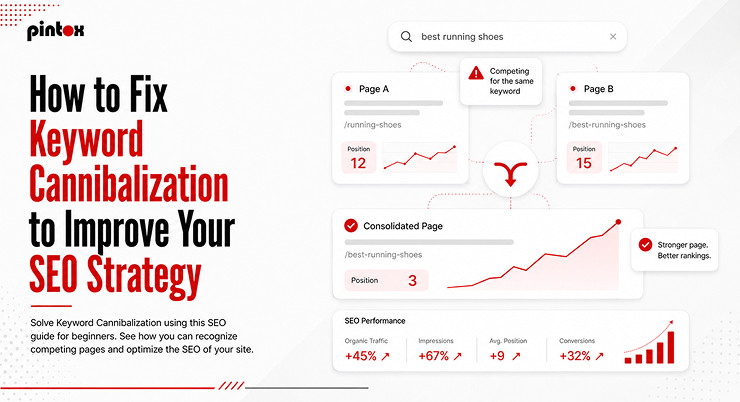
When you’ve dedicated time to creating high-quality content and yet your ranks continue being unpredictable, then keyword cannibalization might just be one of the problems behind it all. Website owners do not realize that they have several pages targeting the same keyword at some point in their lives. These pages start competing against each other until it becomes hard for the search engines to determine which page should be ranked higher.
Your website suffers from keyword cannibalization in SEO more than you think, particularly when it has been creating blogs, landing pages, and service pages for years now. The best thing is that once you learn how to spot it and implement the proper fixes, then it will be easily managed.
In this article, you will learn what Keyword Cannibalization is, why it impacts your rankings, how to spot it, and how to fix keyword cannibalization effectively.
What Is Keyword Cannibalization?
Keyword cannibalization arises from having several pages on the same site optimize for the same keyword or serve the same search intent. While the aim of creating those pages would be to improve your website’s ranking, the result would see such pages fight against each other in search engine results.
Consider a situation where you have a blog called ‘Best CRM for Small Businesses’ and another one titled ‘Top CRM Software for Small Business Owners’ on your site. In case the two blogs are optimized on the same keyword, then the search engines might find it difficult to determine which blog needs to rank higher.
The consequence is the creation of competing pages, the splitting of ranking signals, and reduced authority of the pages.
The thing to realize here is that keyword cannibalization in SEO does not mean the use of the same keyword in several places on your site. There is no problem if your website features the same keyword on different pages.
Why Keyword Cannibalization Hurts SEO
As multiple pages fight over the same search queries, the website confuses the search engines about what it wants to communicate to them. Rather than focusing on creating a single page with authority, the website divides its authority into various pages.
The following are some typical problems that arise from keyword cannibalization:
- Low search visibility
- Organic traffic losses
- Ranking volatility
- Confused URL rankings
- Low page authority
- Losing chances of becoming an authoritative topic
For businesses looking to increase their local search engine rankings, the issue may impact not only their content pages but also their location pages and services pages since similar content competes for identical keywords.
Signs Your Website Has Keyword Cannibalization
There is an alarming number of websites that are not even aware that they face the issue of keyword cannibalization. There are a few signs that could give us a clue whether our website suffers from this problem.
You may face the problem of keyword cannibalization in case of:
- Same keyword ranked by multiple pages
- Frequent changing of positions in search results by your pages
- Ranking loss without any significant changes in algorithms
- Several blogs that deal with similar issues
- Low CTR despite high impression numbers
- Poor SEO results after new content publication
- How to Find Keyword Cannibalization
How to Find Keyword Cannibalization
Before you can fix keyword cannibalization, you first need to identify where it exists.
Review Google Search Console
The simplest way to do this is by using Google Search Console.
Go to the Performance tab and search for your main keyword. If multiple URLs show up in impressions or clicks for the same keyword, check if they are answering the same search intent.
It is not a problem per se, but it could be a start for further research.
Do SEO Content Audit
An SEO content audit will help you identify any overlapping content on your site. Check all relevant pages and documents:
- Target keyword
- Search intent
- Ranking position
- Organic traffic
- Internal linking
- Quality
Such a keyword cannibalization audit usually brings out pages that could either be improved or merged.
Use Professional SEO Tools
Using tools such as Ahrefs Site Explorer and Semrush Position Tracking, keyword monitoring has become much more convenient on many pages.
Such tools emphasize:
- Keywords with shared ranking
- Ranking trend
- Traffic forecast
- Overlap in keywords
- Position change in search
Some of them can be a good keyword cannibalization checker tool that can help find conflicting pages.
How to Fix Keyword Cannibalization Step by Step
After discovering the problem, now comes the time to fix keyword cannibalization using the right approach.
1. Discover the Search Intent
Every web page must satisfy only one search intent.
Think about it:
- Is it an informational page?
- Is it a transactional page?
- Is it an educational page?
- Or is it a lead generation page?
Two pages that answer the same query will definitely compete. Good search intent optimization can solve most ranking issues right from the start.
2. Merge Similar Articles
In case two articles discuss the exact same information, content merging is always the right approach. Instead of keeping two weak pages, create one page out of them.
Content merging will help you to:
- Establish authority
- Create user value
- Enhance your page’s ranking potential
- Gain more backlink equity
Many websites have managed to merge similar blog posts into one single, high-ranking guide.
3. Use 301 Redirects When Needed
After consolidation, use 301 redirects from the old page to the new one. This will ensure that users and search engines arrive at the right place without losing ranking power.
Redirects need to be carefully executed so as not to cause redirect loops and other problems for the website architecture.
4. Enhance Internal Linking
Internal links show search engines what is important on your site. Don’t link randomly, but rather point supportive articles to your main article.
This will enhance:
- Content relevancy
- Navigation for visitors
- Page Authority
- Overall SEO of the site
5. Improve Keyword Targeting
There are times when pages don’t have to be combined. Optimize the keyword targeting approach such that each page focuses on different audiences or questions.
Examples include:
The first article focuses on:
“CRM automation for beginners”
And the second one on:
“CRM automation software comparison”
Long-tail keywords allow you to reduce competition and increase the number of search terms where you appear. Proper keyword research makes this approach simpler to achieve.
6. Apply Canonical Tags Prudently
In situations where similar pages have to be kept alive for business reasons, canonical tags can point to which page deserves to rank.
Canonicalization will work in situations where duplicate or near-duplicate content can’t be eliminated. Nonetheless, canonical tags aren’t a substitute for fixing major content overlap issues.
7. Remove Poor Content
At times, it might be best to delete the outdated pages. Applying content pruning or content pruning SEO strategies can help eliminate thin content that does not offer value anymore.
Removing pages improves:
- Indexation
- User experience
- Quality
- Crawl budget
Tools to Detect Keyword Cannibalization
Several SEO platforms make identifying keyword cannibalization much easier. Some of the most trusted options include:
Google Search Console
Ideal for reviewing search queries, impressions, clicks, and page performance directly from Google.
Ahrefs Site Explorer
Excellent for identifying keyword overlap, monitoring backlinks, and evaluating backlink authority.
Semrush Position Tracking
Provides detailed keyword tracking, ranking history, and visibility reports.
SEO Crawling Tools
Website crawlers can uncover:
- Duplicate titles
- Thin content
- Duplicate content
- Broken internal links
- Technical site issues
These insights often support broader technical SEO improvements, making your website healthier overall.
When Keyword Cannibalization Isn’t Actually a Problem
Not every instance of multiple pages ranking for similar keywords requires action.
For example, you may have:
- A service page targeting buyers
- A blog answering common questions
- A case study showing real results
Although they may share related keywords, each serves a different purpose and satisfies different user intent.
Similarly, large websites often rank several pages for broad topics without hurting performance because each page addresses a unique aspect of the subject. Always evaluate search intent before making significant changes.
Best Practices to Prevent Keyword Cannibalization
Preventing Keyword Cannibalization is much easier than fixing it later. Here are several habits that keep your content marketing strategy organized.
Create a Keyword Map
Assign one primary keyword to every important page before publishing new content. A documented keyword map reduces duplicate keyword targeting and makes future planning easier.
Build Topic Clusters
Organize related content using topic clusters connected to comprehensive pillar pages. This structure improves navigation, strengthens authority, and creates a clearer content hierarchy.
Perform Regular SEO Audits
Schedule a full SEO audit every few months to identify overlapping content before it affects rankings.
Review:
- New content
- Existing rankings
- Internal links
- Search performance
- Content opportunities
- Focus on User Intent
Instead of publishing multiple pages targeting identical phrases, create content that answers different questions. Prioritizing users over search engines naturally reduces cannibalization.
Keep Content Updated
Older articles should be reviewed regularly to ensure they remain accurate and continue serving a unique purpose. Refreshing existing pages is often more valuable than creating another article covering the same topic.
As part of a long-term digital growth strategy, maintaining a well-organized content library also supports stronger authority, better user experience, and a more effective lead generation strategy.
Frequently Asked Questions
How do I detect keyword cannibalization?
Keyword cannibalization may be detected by checking Google Search Console or using SEO tools such as Ahrefs or Semrush, or through site: yourdomain.com “keyword”.
Does keyword cannibalization influence rankings?
Sure. It might spread ranking signals, links, and CTR between similar pages.
Should I remove one of the competing pages?
No, not always. It depends on the case whether you should merge pages, change keyword strategy, implement proper internal linking, use canonical or redirection instead of removal.
Is keyword cannibalism equal to duplicate content?
No. The term “duplicate content” means the same content, while keyword cannibalism happens when there is competition between different pages for the same keyword.
What tools can help detect the problem of keyword cannibalism?
The Following are the tools that can help detect the problem of keyword cannibalism
- Make a keyword map before creating new content;
- Target a unique search intent for each page;
- Create topic clusters;
- Conduct SEO content audits.
Can a blog post cannibalize a service page?
Sure, it can. When the two pages aim for the same keyword and intention, then the blog post will outrank the service page. The best thing would be to differentiate intention and improve on internal links.
Final Thoughts
It is worth noting that keyword cannibalization may silently restrict your website’s growth, despite the quality and informative nature of your content. When multiple pages target the same search intent, it becomes impossible for search engines to understand which page should rank, thus affecting visibility and overall performance negatively.
There are several ways to deal with keyword cannibalization in SEO. Conducting a keyword cannibalization audit, evaluating your content strategy, improving internal links, consolidating similar pages when it is necessary, and making sure that each page has its own unique purpose will increase the chances of your website succeeding in its search efforts.