
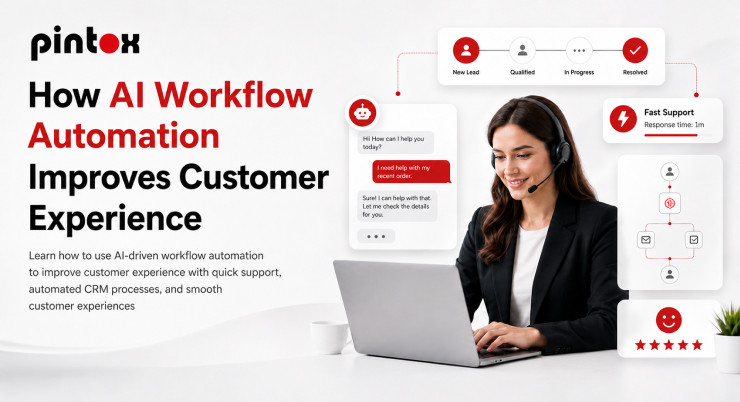
It is essential for the customers to receive a fast reply, personal treatment, and a consistent experience every time they interact with the company. But the problem with traditional processes is that there is always a delay, no follow-up, and inconsistency.
Here comes the advantage of AI workflow automation. Thanks to its automation capabilities, companies are able to provide timely answers, streamline communication, and ensure consistency. Whether it is automatic lead reply, automatic appointment reminders, updating the CRM, or responding to customer support requests, AI customer experience automation allows making things easier for teams and providing a better customer experience.
Currently, many companies use customer experience automation to increase response rate, improve their relationship with their clients, and provide them with reliable support using AI chatbots, AI voice agents, as well as automated CRM workflows. In this article, we will discuss how AI workflow automation impacts customer experience, what advantages it provides, and what practices should be followed when using it.
What Is AI Workflow Automation?
Workflow automation using artificial intelligence is the process through which a business task is automated using AI technology that makes smarter decisions depending on the information provided by the client. In comparison to the other type of automation, workflow automation using artificial intelligence adapts and improves.
For instance, whenever a client provides an inquiry, the workflow software powered by AI technology automatically captures the client’s data, assigns the lead, sends a confirmation email, follows up, and updates the CRM. Thus, workflow automation saves time by offering faster and more consistent communication.
Businesses have started to adopt workflow automation using AI in managing leads, customer onboarding, customer support, sales pipeline, CRM workflow automation, and appointment reminders.
The main benefit of workflow automation using AI technology is that businesses are able to automate workflows without losing the human touch. As the automation technology performs repetitive tasks, employees can concentrate on building relationships with customers and providing solutions.
Why Customer Experience Matters More Than Ever
Customer experience is one of the main drivers of business success. The competitors can duplicate price and product strategy, but it is significantly more difficult for them to provide an experience on par with what the company provides. In the modern world, customers want fast responses, personal communication, and an effortless customer journey.
It is the reason why companies develop AI-driven customer experience automation solutions, which make response and communication faster, more efficient, and provide a better customer journey. Any delays and problems with customer experience, such as a lack of response or follow-up, may influence customers’ decisions and drive them away.
Automation of customer experience allows companies to provide confirmation, reminders, follow-up information, etc., automatically without involving any additional staff.
Using AI automation also increases efficiency internally. Staff members get to use less time performing repetitive chores and more time adding value through customer engagement, making them more productive.
It is not necessary to communicate more; what matters is to communicate better. It becomes easier to create consistency in customer experiences, which builds trust and makes customers loyal through business process automation and personalization of communication.
How AI Workflow Automation Improves Customer Experience
What is the main benefit of automating an AI workflow? It will optimize all the stages of the customer journey while not adding any extra workload to your employees’ shoulders. Rather than approaching workflow automation through various stand-alone solutions, businesses that understand the true power of AI integrate all these tools in the form of connected workflows, which will facilitate the process of communication, starting with the first inquiry and ending with post-sale customer service.
One of the first benefits that your clients may feel is the increase in speed. When working manually, unnecessary delays occur as employees have to read emails, allocate tasks, update spreadsheets, schedule reminders, etc. This process may result in the loss of your potential customer’s attention or his/her interest in choosing another business.
Through the process of intelligent workflow automation, all these routine actions take place instantly. Inquiries get automatically captured, customer data gets added to your CRM system, tasks get allocated to the right departments, and customers get confirmation right away.
Moreover, automation can help you engage customers and make personal interactions happen. There is no need for generic email campaigns. Instead, the system will analyze your customers and send a message to them depending on their activity, preferences, purchase history, or inquiry history. It means that returning customers and new visitors get different communications.
CRM workflow automation is another huge advantage for businesses. You do not have to worry about customer interaction records because every contact will be stored automatically. It means that the marketing, sales, and support teams will have the same information regarding customer contacts.
Lead nurturing can be automated as well. It will keep your leads active without additional efforts. When people download any guides, make requests for quotes, book consultations, etc., they will get a series of personalized communications (via email, SMS, educational material) until the decision-making moment.
The support team also experiences positive changes because all incoming requests are automatically routed using intelligent task routing and automatic ticket assignments. People get connected to the right specialist immediately.
Consistency in communications via multiple touchpoints is achieved as well. No matter whether customers reach out to your business via your website, emails, social networks, texts, or phone calls, automation helps establish omnichannel communications, meaning that all communications will remain consistent.
In the end, workflow automation based on artificial intelligence gives you an opportunity to offer a degree of responsiveness and personalized treatment which would otherwise be hard to accomplish without AI. Your clients get quicker responses and better communication overall, while your employees have enough time to offer top-notch customer service. This approach ensures higher customer retention and trust.
Faster Response Times Mean Happier Customers
Immediate responses are important, and any delays might lead to losses of significant value for businesses. The key benefit of using AI workflow automation is that the process allows you to respond faster without extra workload for your staff.
In case a client submits their request or makes a booking, automated workflows allow sending instant notifications and transferring the task to a specific team member automatically. You do not have to worry about the loss of any leads or other issues.
Moreover, businesses often use AI-based customer services, AI chatbots, and AI voice agents to provide immediate assistance for common requests and calls. Instant customer support even after working hours is another significant benefit.
Faster customer response and consistent customer communication lead to increased customer satisfaction, and at the same time, your employees can communicate with customers personally.
Personalized Customer Journeys with AI
Every customer has unique needs, making personalized communication very important today. With AI customer experience automation, companies will be able to provide timely and relevant communications tailored to specific behaviors, preferences, and purchase stages of customers.
Rather than sending out unspecific emails, businesses will be able to automate sending of such timely messages as welcomes, reminders, follow-ups, and recommendations. Personalized communication with the customer will be achieved without compromising the level of engagement.
Thanks to the CRM integration, all communications will be documented for further access by the sales and customer service teams, as they have access to the whole history of the customer. This way, there will be no need for repeated conversations, and a seamless customer experience via email, SMS, calls, and live chats will be achieved.
Automating Follow-Ups Without Losing the Human Touch
Follow-up is among the hardest tasks for developing companies. The hectic schedule makes it easy to overlook prompts, forget about following up with clients, or postpone sending an answer. Workflow automation using artificial intelligence takes care of automatic delivery of emails, SMS, and reminders while keeping the communication personalized.
Companies can benefit from email workflow automation, SMS automation, as well as an automated follow-up system to work with potential clients, arrange meetings, ask for feedback, and reach out to dormant customers. The reason these communications are so effective is that they are sent depending on the customers’ activity.
The AI takes care of the communication process, while the employees take part in it only in case of the need for additional knowledge and relationship-building.
AI Workflow Automation Across Every Customer Touchpoint
This is because the customer journey does not start and end with purchasing. Every point of contact matters, and AI workflow automation allows organizations to maintain a consistent customer experience throughout the entire process.
CRM workflow automation, customer onboarding automation, automated customer communication, and automated customer updates make sure that all relevant information is shared across departments, and customers always know what the next step is.
By using workflow automation for customer service, businesses are also able to improve customer lifecycle automation in order to have even more effective customer interactions.
Industries That Benefit the Most
Almost all sectors would benefit from AI-based automation of customer service process workflow, however, there are those that benefit the most compared to the others.
Automated appointment reminders and patient engagement are common uses of workflow automation in healthcare organizations. Lead generation and qualification is commonly used by real estate agencies. Retailers and e-commerce websites apply AI lead management to customize the shopping experience and cart abandonment recovery.
Home service companies, financial organizations, education organizations, and marketing companies make use of AI automation tools as well as workflow automation services.
No matter what type of industry you are in, customer experience automation allows you to provide faster service, build better relationships with your customers, and operate more efficiently.
Common Mistakes to Avoid
Although automation has its advantages, bad practice may bring more issues than benefits. One of the most frequent mistakes related to automation is attempting to automate all kinds of interactions with clients. Automated processes should solve simple repetitive tasks; however, complicated issues still require human touch.
One more mistake to avoid is applying unconnected solutions, which cannot be integrated into the existing CRM system. Ineffective workflow management in your CRM will make customer data distributed and lead to duplicate messaging.
Moreover, you need to periodically update your automation process as your business grows and develops.
How to Get Started with AI Workflow Automation
AI workflow automation need not necessarily be too complicated to start off with. First, try to identify those activities which eat up most of your time, such as lead management, appointment booking, customer onboarding, or any other such tasks.
Then pick up a good AI workflow automation software which is compatible with your CRM and mode of communication. Experiment with one or two workflows first, see how well they work out, and then proceed further.
Ultimately, you do not want to automate processes just to get rid of your employees but rather to make them more effective.
Frequently Asked Questions
What is AI workflow automation in customer service?
In customer service, AI workflow automation means the application of AI technology for the automation of tasks such as inquiry routing, follow-up notifications, CRM updates, and faster assistance.
How can AI workflow automation improve the customer experience?
It will result in a quicker reaction, personalized communication, and consistency of the service throughout the entire interaction process with the customer.
Can AI automation decrease customer response time?
Yes. By automating the process of sending responses and routing inquiries, and by automatically assigning tasks.
How does workflow automation enhance customer satisfaction?
Through communication, the reduction of human mistakes, and customer updates at every step of the process.
How can AI workflow automation personalize customer interactions?
Through the use of customer information and behavior, AI can send relevant messages to customers and make follow-ups.
Can small businesses make use of AI workflow automation?
Definitely. Small businesses can implement AI workflow automation in order to be able to save time, become more efficient, and provide great customer service without increasing staff size.
Can AI workflow automation help to retain customers?
Sure. It helps to build trust through regular communication and personalization of experience, thus providing higher customer satisfaction.
Final Thoughts
Expectations of customers will only increase, and companies that are dependent on manual processes will find it hard to cope. AI workflow automation is a much smarter approach, which will help businesses deliver faster and better experiences that are consistent and personalized without adding any complexity to the process.
By lowering response time and improving the follow-up, improving the communications on all the touchpoints, AI customer experience automation will make it easy for organizations to ensure that their customer experience journey becomes easier and more engaging. This approach will also enable businesses to give space to employees to engage in meaningful conversations and not the mundane processes.