
You might have a website with hundreds of blog posts, but still not be able to do anything for SEO.
There is an article dedicated to keyword research. Then comes on-page SEO, local search, and outdated posts that don’t seem to be related to anything else.
It is a usual situation. In some cases, the problem is not even the quality of separate articles. Sometimes, what really fails is their coherence.
This is when a topic cluster becomes helpful.
Unlike creating single articles depending on which keyword seems the most promising at the moment, you create a set of articles devoted to one topic. One page touches upon the topic from a general perspective, and others answer more specific questions. These pages are connected by the relevant links to each other.
What Is a Topic Cluster?
A topic cluster is basically a set of content created on the basis of a single topic.
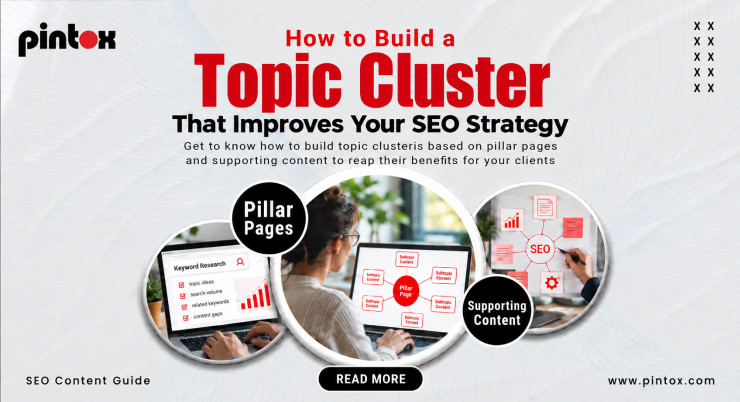
In the middle is the so-called pillar page, which is the most extensive content dedicated to the main topic. Then there is more focused content created to answer particular questions or to cover particular subtopics.
For instance, let’s say that we have a digital marketing agency that decided to create a topic cluster for local SEO.
The central pillar would be:
The Complete Guide to Local SEO
The subtopics of local SEO may include:
- How to Optimize a Google Business Profile
- Local Keyword Research for Service Businesses
- The Impact of Online Reviews on Local SEO
- How to Improve Your Google Maps Presence
- Local Citations and What They Are For
- Local SEO for Several Locations
All of the above are not separate, unrelated blog posts; they all have something in common.
It is what topic clusters are about. Instead of asking yourself, ‘Which keyword should I use in my next post?’ now you will ask, ‘What does my target audience need to know about the topic?’
Just one phrase and your SEO content strategy is dramatically improved!
Why Topic Clusters Matter for SEO
Content does not equate to depth within a website.
Imagine a firm that writes 50 articles on 50 different issues. The website might be quite extensive, yet there is no evidence pointing to the areas of expertise of the company.
Compare this to another company that writes 20 interlinked articles on one specific issue. This second website has more structure and hierarchy of content.
They Help You Create Topical Authority
Topical authority is basically the process of showing depth on a subject.
To create topical authority on a topic such as SEO, for example, you won’t be able to do this with only one article. You can talk about such aspects as keyword research, technical SEO, on-page optimization, internal linking, local SEO, content optimization, and others.
The goal is not just to create new content. Every new post should bring value to the topic.
This is why the topic clusters usually grow. First, you choose a key topic and then fill the gaps with valuable supporting content.
They Bring Structure to Your Blog Content
Without the plan, your blog might get messy. You will have very good articles, but they will be everywhere on your website. Some posts will duplicate each other. Others were written years ago. Service pages will be almost without any links to other pages of your website.
A topic clusters approach brings order to your website content structure.
They Improve Internal Linking
Internal links should not be included in articles just because a checklist on search engine optimization says so.
The links should serve the purpose of the reader.
For instance, when you are explaining keyword research and talk about search intent, including a link to an article on search intent is logical. And if the article includes links to your SEO guide, you have created a useful path from one page to the other.
This is where an internal linking strategy plays its part in a much better way.
Pintox has discussed how good internal linking can link relevant informational content to important commercial webpages, especially those with local services.
Topic Clusters vs. Writing One Article for Every Keyword
Keyword research isn’t an issue. What goes wrong is when keyword research becomes the only aspect of content strategy. So let’s assume you’re making a website for a web design firm.
You may come across keywords like:
- website design
- responsive web design
- mobile-friendly websites
- website design process
- website redesign
- website navigation
- website user experience
You can write a separate article for every phrase.
But do you have to?
Not really.
Many of the phrases are somewhat similar to each other. Writing a separate page on each minor difference can end up creating redundant articles.
The proper thing to do would be to look at the big picture and see which of the questions need a separate page of their own.
Here’s where semantic SEO steps in. Rather than focusing just on the keywords, you will see what the concept is all about, what the related questions are, etc.
How to Build a Topic Cluster
Creating a topic clustering strategy for SEO doesn’t need to begin with creating a large content calendar. Start with one topic that really counts for your business.
1. Identify a Topic That Counts for Your Business
Instead of asking, ‘What is the keyword with the most searches?’
Ask:
Which topic do we wish to position our business in?
For example, if your business is an agency, then it might be the topics of SEO, paid advertisements, local marketing, or marketing automation. If your business is an accounting company, then it may be small business accounting or tax planning.
This should be a topic that fits well into your service and interests your customers. It should also be a topic with enough substance to create several pieces of content.
2. Build Your Content Pillar
After identifying your primary topic, the following step is developing your content pillar.
The pillar page is supposed to be your resource on that particular topic. The purpose of the pillar is to inform readers about the subject matter, discuss all the necessary points, and provide links to more in-depth material. It doesn’t necessarily have to provide all the answers to the matter in one single article.
For example, a digital marketing agency could come up with a guide titled:
‘Digital Marketing for Small Businesses: A Complete Guide’
It would cover such topics as SEO, content marketing, social media marketing, PPC, email marketing, and analytics. Each of those points would have a link to a separate article for those who wish to dig deeper. That is the purpose of pillar pages in your content strategy.
3. Find the Questions Around the Main Topic
Here comes the research part. Start by looking at your customers’ demands. Analyze related searches and autocomplete suggestions provided by Google. Analyze your competitors’ content as well. Also, look at all your existing articles.
Keyword research tools can assist you in your research, but numbers aren’t the only thing that matters.
For each potential topic, consider asking yourself the following questions:
- Is it really necessary for our target audience?
- Does it deserve to be placed on a new page?
- Is there another search intent behind it?
- Are we covering it somewhere else?
- Can we offer something more interesting than what is already available?
4. Create Focused Cluster Content
Your supporting articles need to be more specific than the pillar page. If the pillar page talks about local SEO, the supporting article can address Google My Business optimization. Another article can be about local keywords research. Another one can discuss review management.
In other words, cluster content should go further than the corresponding part of the pillar page. It’s unnecessary to duplicate the same paragraph on multiple pages.
Assigning a task for each article is one of the simplest methods to prevent your site from redundant content.
5. Connect the Pages Naturally
When you have everything ready, start linking the pages together.
The pillar page must be linked to relevant and informative articles. These articles can link back to the pillar article in cases where that makes sense. Related cluster pages may also be interlinked.
Such as:
Local SEO Guide
?
Local Keyword Research
?
How to Identify ‘Near Me’ Keywords
And:
Local SEO Guide
?
Google Business Profile Optimization
?
How to Improve Google Maps Presence
These links must make sense within the sentence. You cannot force in links just for the sake of including another keyword.
A Simple Example of a Content Cluster
Take, for example, a business that provides marketing services for small companies and seeks to gain more visibility through content marketing.
For instance, the primary pillar topic could be:
Content Marketing: A Complete Guide for Small Businesses
Some additional articles may include:
- Creating a Content Marketing Strategy
- Creating a Monthly Content Marketing Calendar
- Ideas for Blogs for Local Businesses
- Content Marketing and SEO
- What Metrics to Measure with Content Marketing
- Mistakes in Content Marketing
- How to Repurpose Your Blog Posts
Now there is a connection between these pages. A visitor of the main guide could look into a particular topic. A user who found an article via Google could go to the main guide and get additional information on related topics.
It’s definitely better than having seven articles in the blog archives without any connections between them.
What About Existing Content?
This is one aspect that businesses tend to ignore. Creating a cluster does not always mean creating new content. Maybe you have a good number of 10 or 20 articles on various aspects of the topic. Maybe all you need is for them to come together.
Before embarking on writing a new set of articles, it is important to do an audit of what you already have.
Some aspects to look at include:
- Article with related topics
- Pages that target the same intent
- Old articles that require revision
- High-quality articles with low internal links
- Vital services that are not linked to relevant articles
In some cases, structuring the content that you already have might help your website more than adding new generic blog articles.
Common Topic Cluster Mistakes
Making a Page for Each Keyword Variation
It’s not always necessary to write an individual article for each keyword variation. Three similar keywords will likely be better served by one comprehensive page rather than three individual weak pages.
Making the Pillar Page Too General
Your pillar page must be comprehensive but not excessively long, i.e., a 10,000-word encyclopedia. Describe the topic thoroughly and redirect visitors to pages with additional information about a particular subtopic.
Creating the Supporting Content without a Strategy
If every individual page is written separately, you risk creating overlap and missing opportunities. Think of the connections between the pillar page and its supporting pages prior to creating any article.
Forgetting about the Internal Links
Even the best content won’t get noticed if no one links it to the rest of the website. Think about how the newly published page fits into your content cluster strategy every time you write a new article.
Using Traffic as the Sole Metric
Having increased traffic is a good thing. However, traffic is just traffic until it tells you how effective a page really is.
100 visitors who have found interest in what you are offering could be more valuable to your company than 1,000 visitors who haven’t. What actions are the visitors taking on the page? Are they clicking on another blog post? Contacting you? Asking for a quote? Making an appointment? Downloading anything?
This gives you a better idea of the value of your content. What the SEO process tries to accomplish is not only bringing more visitors to the website, but bringing the right visitors.