
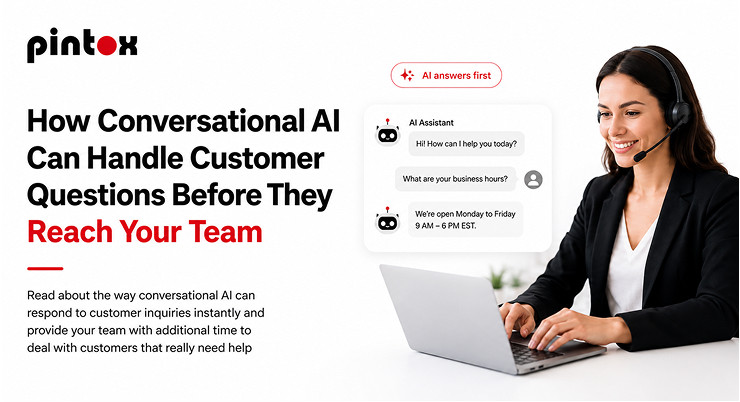
It doesn’t necessarily mean that customers need your response via email or need a team member on their phone to answer their concerns. They just need an immediate answer to some straightforward questions like “What are your operating hours? How much does this service cost? Are you available in my area? Is there a way to schedule an appointment?”
Answering all these requests over and over again throughout the day can take much of your team’s time.
This is how conversational AI can become a great solution.
Rather than forcing your team to reply to all these common inquiries, conversational AI will engage customers from your website and help them by providing necessary responses and inviting a human agent once it is needed.
The purpose of AI Chatbot is not to replace your customer support team. It is supposed to manage repetitive communication while letting your agents take care of other things.
What Is Conversational AI?
Conversational AI is a solution that allows companies to communicate with their clients more easily. Unlike the conventional communication when there is nothing else to do other than choosing a certain menu or keyword, with this technology it is possible to comprehend the sense of the formulated question and give an appropriate answer.
Therefore, while one customer asks:
“Do you have weekend appointments?”
Another customer will ask:
“Can I book something for Saturday?”
Even though such questions may seem different, the essence of both of them is the same, and the AI will understand that and provide a corresponding answer without making the client choose any option from the list.
This technology will come in handy when you have many inquiries to your company on your website, live chat, SMS, or social media. This will save you the effort of your team members answering the simple questions since conversational AI will take care of everything for you.
How Can an AI Chatbot Handle Customer Questions?
An appropriately programmed AI chatbot may become the initial point of interaction between the company and its clients.
It is not that hard.
The client makes a request. The system receives the request, determines whether there is enough information about it, and gives an answer. In case of a request falling beyond the scope of its duties, it can transfer the conversation to a colleague.
For example:
Client: “Can you redesign a website?”
AI chatbot: “Certainly. We will be happy to help with the website design and redesign of landing and conversion-oriented pages. May I ask what you need to improve on your website?”
The client can go on with the conversation without wasting time waiting for another person to become available.
Common Questions AI Can Handle
An AI chatbot will be able to provide answers to the following questions depending on its training:
- Product or service
- Price range
- Business hours
- Location or service area
- Availability of appointments
- General policies
- Delivery
- FAQ
- How to get started
- Contact details
- General service requirements
What really matters is not the mere existence of the AI chatbot. The system has to have correct information and proper limitations.
If there are frequent changes in your business information, the AI should also know about the updated information and not give outdated answers.
AI Agent vs. Traditional Chatbot
Here lies the significant difference between a regular chatbot and an AI agent.
A conventional chatbot usually operates on preset flows.
For example:
Select an option ? Choose a service ? Fill in a form
Such a flow works well enough in the case of simple dialogues, but is insufficient for addressing queries that fall out of predefined paths.
An AI agent is capable of handling more versatile conversations, being able to interpret natural language, extract information from the knowledge base, ask additional questions, and perform certain actions in some cases.
Thus, an AI agent is capable of doing things like:
- Asking what kind of service the client requires.
- Identifying the customer’s location.
- Checking whether the service is available in this location.
- Getting contact details.
- Qualifying the query.
- Scheduling an appointment.
- Routing the conversation to the right team member.
And here comes the true power of AI.
AI Customer Service: What Should AI Actually Handle?
The most effective AI customer service solution will not be an attempt to automate the entire process. Rather, it will divide straightforward inquiries from those that will require human input.
For instance, AI can manage the following:
Simple inquiry:
“Do you have free consultations?”
Basic request:
“How can I make an appointment?”
Request for information:
“What kind of services do you have?”
However, there is still a possibility that human intervention will be necessary when it comes to:
Complicated complaint:
“I was double-charged; I need this to be sorted out.”
Sensitive topic:
“I am unsatisfied with your service.”
Negotiations:
“Can you offer me another price?”
The aim is to ensure that the transition is smart, not to put the customer in the position to tell the whole story again.
How Customer Support Automation Saves Your Team Time
Customer support automation becomes most useful in eliminating repetitive activities.
Consider a business getting 100 customer interactions a day. If 40 out of 100 interactions consist of routine queries that can be addressed straightaway, there has been quite an amount of time spent on activities that do not necessarily have to be carried out by human beings.
Your AI system will attend to the routine interactions while your team gets engaged in other tasks.
Some of these benefits may include:
- Quick first responses
- Fewer repetitive interactions
- Decrease in workload
- Availability beyond office hours
- Consistent responses
- Quick lead qualification
- Improved customer experience
This ensures that customers do not always have to wait till the next day to receive answers to simple questions.
AI for Small Business Can Be Especially Useful
While an enterprise can afford round-the-clock availability of its customer service, it would be much more difficult for a smaller firm.
Indeed, an entrepreneur will have to deal with sales, running the operations of the firm, meetings, answering questions, doing administration, among many other things.
It is at this point where small business AI proves useful.
The AI can answer a question while the entrepreneur is on the phone, dealing with another client, or just out of sight from the computer. It does not mean that the AI should substitute the entrepreneur. All it means is that no question turns into a new thing to do immediately.
It is a huge difference for a small firm.
AI Website Bot: Your First Line of Customer Communication
An AI Website Bot can be placed right onto your website and communicate with the visitors while they visit.
It is important because people visiting a website very often will leave a business without contacting it because they can’t find the information that they want to find.
An AI Website Bot can come into play and say:
“Can I help you find something?”
And the visitor will reply:
“I need some help with SEO for my local business.”
Then the AI will describe its relevant service and ask several clarifying questions to move the conversation forward. Instead of letting the visitor look around all of the pages on their own, the conversation will bring all of the information to them.
The same thing works with the service businesses, agencies, health care organizations, home services, SaaS companies, and so on.
AI Can Also Help With Lead Qualification
Questions raised by customers and sales conversations tend to coincide. A person asking “Do you deal with companies from Texas?” may just seek information. However, he or she might consider your offer. This is when lead qualification by AI proves to be helpful.
The algorithm can ask related questions like:
- What service do you want?
- What kind of company do you have?
- Where does your company reside?
- What do you want to improve?
- When do you plan to start?
The gathered data can be used to decide whether this question should go to sales. Instead of forwarding every online visitor to sales agents, the system helps to distinguish which conversations need to be prioritized.
Where an AI Auto Responder Fits In
The AI auto responder is especially handy when time is of the essence.
Let’s say that a person fills out a form at 9:30 PM.
Without automation, the lead will have to wait till the following business day. But with the AI auto responder, you could send the customer a message right away that would confirm receipt of the inquiry and answer the most common questions.
For example:
“We have received your message. We offer website development and digital marketing services. Do you need to improve your current website or create a new one?”
This way, the interaction continues. The information is also useful for your team in the future.
What About a GoHighLevel AI Bot?
Businesses already using GoHighLevel can connect conversational experiences with their CRM and automation systems. A GoHighLevel AI bot can be used alongside workflows, pipelines, follow-ups, calendars, and customer information. This makes it possible to connect the conversation with what happens next.
For example:
Website visitor
?
AI conversation
?
Basic questions answered
?
Lead qualified
?
Contact created in CRM
?
Appointment offered
?
Sales team notified
This type of connected setup is much more useful than having an AI chatbot operating separately from the rest of the business. Pintox provides GoHighLevel automation services that can connect CRM workflows, automation, AI agents, follow-ups, and other business processes into a more organized system.
When Should AI Hand the Conversation to a Human?
This is one of the most critical components of AI customer service. There are clear limitations that AI needs to have.
The transfer of the conversation should take place when:
- The client requests a person.
- The query has some personal information.
- The client is angry and complains.
- The query needs judgment or negotiations.
- AI lacks sufficient data to respond to the query.
- The client’s problem is complex.
- There is a need for purchase decision-making.
The transfer must be smooth and natural. Instead of saying “I cannot help you,” the AI can say something like “I want to ensure that you will receive the correct response, and I will put you through to one of our colleagues.” This slight change can make a big difference for the client experience.
How to Build Conversational AI That Actually Helps Customers
Adding AI on your website can be quite simple. Creating an effective AI that people will use, however, needs some planning.
Start With Real Customer Questions
Review your emails, chats, support tickets, phone conversations, and FAQs.
What questions are the customers already asking you?
Those questions will be the basis of your AI’s knowledge.
Provide The AI With Enough Information
The AI should know about your:
- Services
- Policies
- Working hours
- Location
- Price information
- Appointment schedule
- Commonly asked questions
- Communication channels
Do not give the AI vague directions and expect it to provide perfect responses.
Establish What AI Should Not Do
The AI knows where to draw the line. Setting limits will minimize the number of wrong answers and facilitate handover to humans.
Connect It to Your CRM
The conversation gets even more valuable if the data is automatically entered. For instance, the AI could record a customer’s name, inquiry, interest in services, and qualifications, and send it straight into the CRM.
This way, your team will not need to copy the data manually. For those who need a comprehensive CRM solution, automation, and follow-up infrastructure
Conversational AI Should Support Your Team, Not Replace It
The worst thing businesses can do about conversational AI is considering it as a replacement for human customer service. After all, customers prefer talking to real people if they have some serious questions.
The real power of conversational AI is in its ability to take care of all these inquiries and let your team spend more time on more relevant discussions.
At first glance, a good AI system should be easy for the customer to use – he asks a question and gets an informative answer before talking to a person.
However, from the perspective of your business, this process will help save some time, collect more qualified data, and organize customer conversations.
Frequently Asked Questions
Q1: What advantages does conversational AI offer for customer service?
Ans: It can provide the answers to the most commonly asked questions, give an immediate response, gather the client’s information, and send the difficult questions to the right employee.
Q2: Is it possible that conversational chatbot will replace the whole customer service team?
Ans: No, the conversational chatbot will be used for the solution of the routine tasks, while the employees will deal with complicated, sensitive or significant tasks.
Q3: What kinds of questions can conversational chatbot answer?
Ans: Conversational chatbot can answer questions concerning services, prices, time schedule, offices, time of appointment, conditions, and other questions that are often asked.
Q4: May conversational AI qualify leads?
Ans: Yes, it may ask qualifying questions, gather information about the lead, learn customer needs and transfer qualified leads to your sales team.
Q5: Is conversational AI helpful for small businesses?
Ans: Yes. The AI software for small businesses will assist you in answering all the customer questions and working outside of business hours.
Q6: Can conversational AI integrate with GoHighLevel?
Ans: Yes. A GoHighLevel AI bot will be able to integrate with CRM records, workflows, pipelines, appointments, and follow-up automation.
Final Thoughts
Conversational AI may be a practical solution for organizations in helping answer customer questions without holding up the customers on each question they ask.
A conversational AI chatbot could take care of frequently asked questions. A conversational AI agent can handle complex conversations. AI customer service can streamline repetitive tasks, while customer support automation will help keep communication active even after working hours.
AI can give a small business the same capability in customer communication that would have needed more staffing otherwise. Also, by integrating AI with a CRM like GoHighLevel, the customer conversations can play into an overall process of qualification, scheduling, follow-ups, and sales.
It is not about having your business become an automated entity.
It is about making the help process easier.
Having conversational AI deal with routine questions while your team focuses on conversations that need their attention can improve both aspects of the interaction.