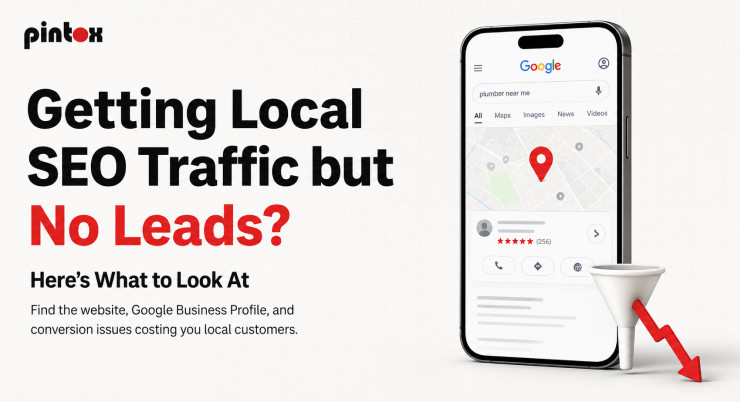
Visibility of your business in local searches is a great start. It means that your SEO efforts pay off, and people find your business when they search for goods or services near their location.
However, what will happen if traffic grows while there are no leads to speak of?
It might be the case that you get more visitors on your site, more views of Google Maps, and more visits to your Google Business Profile; however, your phone remains silent, as well as your contact forms. This situation is common enough; unfortunately, more traffic does not always translate into more clients.
The thing is, if you get the traffic for local SEO keywords but there are no leads, the issue might not lie in your rankings. It may be something else on your website that hinders the conversion of visitors into potential clients.
Fortunately enough, most of such issues can be detected and fixed. Let’s see how.
Traffic Is Not the Same as Lead Generation
A common error companies often make in relation to business growth is thinking that website traffic equals growth.
That is incorrect.
A person who wants to use the services of a company in the area can visit the website for various reasons. He or she can do some comparative research, price check, read reviews, and just try to figure out if the company provides what they need.
The actual question is not:
“How many people are visiting my website?”
It is:
“What are those visitors doing after they come here?”
This is when local lead generation becomes a critical aspect. A successful local SEO strategy implies attracting people who have a good chance of becoming clients. However, if such visitors are leaving the website without making any calls, submitting forms, booking appointments, or making any other inquiries, a company may face traffic but no sales.
1. Check Whether You Are Attracting the Right Local Visitors
Before optimizing your website, it’s important to understand whether traffic from the local search engine is truly relevant. High ranking for general or informational keywords may result in a lot of traffic that is not going to become your client anytime soon.
For example, when it comes to a roofing company, the following keywords may be used to generate traffic:
- How long does a roof last?
- What is the average price of a roof?
- How to fix a small roof leak?
These keywords may help you to boost your website ranking, but they do not indicate purchasing intent at all.
Now, consider:
- roofing company near me
- roof repair in [city]
- emergency roofer near me
- roofing contractor in [city]
These queries usually have a strong commercial intent. Look into the search queries that bring traffic to your website and answer one question.
Is there any purchasing intent in those queries?
If no, then you are most likely getting tons of visits that are not qualified local SEO leads.
2. Review Your Google Business Profile
One of the first places that a prospective client is likely to come across your company is the Google Business Profile.
A customer can come across your Google Business Profile on Google Maps or other local searches before seeing your website. The impression they get from the profile can determine whether they contact you, visit your website, ask for directions, or check out another company. Optimal optimization of your Google Business Profile is not just about providing all the basic details.
Make sure that your:
- Business name is correct
- Primary category is right
- Provided services are listed
- Telephone number is correct
- Link to your website works
- Hours of operation are right
- Service area is appropriate
- Photos are up to date
- Reviews are monitored and responded to
The reviews require special attention. If your competitors’ profiles have dozens of recent and detailed reviews and yours has almost none, customers may have a second thought, even if you rank high. It can be an explanation why your company is visible but has few GMB leads.
If you need assistance optimizing your local presence and transforming search traffic into enquiries, then Local SEO services can be helpful.
3. Look at Your Website Conversion Rate
However, if local visitors come to your website but do not contact you, check your website conversion rate. Your website conversion rate shows you how many visitors perform the desired action and how many visitors there are in total.
If 1,000 visitors visit your website and 20 of them fill out the contact form, your website conversion rate will be 2%.
This percentage requires interpretation as conversion rates differ from one industry to another as well as depending on the source of traffic, offer, and conversion type. The point is to have a benchmark and make it better over time.
Ask yourself:
- Can visitors easily understand what services you offer?
- Is it clear that you serve particular locations?
- Can visitors see your telephone number?
- Is it possible to contact you via smartphone?
- Is your contact form easy to fill out?
- Is there a need for visitors to contact you?
- Are their main questions answered on this page?
If you cannot give clear answers, your SEO works perfectly while your website misses the chance to get in touch with potential clients.
4. Make Your Call to Action Impossible to Miss
The user should not have to look around your website to understand what he needs to do next. Important pages related to local services must have a clear call-to-action. This can vary based on your business type.
It might be:
- Call for a free quote
- Ask for a quote
- Make an appointment
- Arrange a consultation
- Get the service now
- Contact us
The CTA should correspond with the intentions of the visitor. A user who is looking for urgent plumbing services doesn’t really want to know a lot about the history of the company before seeing the telephone number.
The person researching an expensive home improvement may require some information first.
5. Look Closely at Your Landing Pages
However, your homepage might not always be the right destination page for every local search. A person who is searching for “AC repair in Miami” will only create unnecessary labor for yourself if he is taken to a general homepage instead. Ideally, he should be taken to a page that is specifically about AC repair and the area being served.
Here is when landing page conversion comes into play.
An effective landing page should effectively tell people:
What do you do? Where do you do it? Why should the visitor choose you? What should the visitor do next?
Example:
AC Repair Services in Miami
Professional AC repair services for homes and businesses in Miami. Contact us now to schedule service.
Other elements include:
Supplementary information, testimonials, service details, FAQs, pictures, and clear means of contacting you.
The idea is not to create hundreds of pages that are almost identical in nature to each other. The idea is to create pages that are really useful to the local audience.
6. Check Your Website Speed and Mobile Experience
Many searches are conducted using mobile phones.
Imagine a person searches for your service outside their home when faced with an urgent situation.
He/she visits your site; your site is loading for a few seconds; it is difficult to understand the text and the phone number cannot be found at all.
They are unlikely to stay.
Your poorly optimized website is able to secretly lower your conversion rate even though your SEO traffic is great.
Test your website on a real mobile phone rather than a computer.
Check:
- Page loading time
- Text readability
- Easy-to-tap buttons
- Working forms
- Ability to tap the phone number
- Fast appearance of important information
You do not have to have a complex website. You have to have a website which makes actions of a local client easy.
7. Your Offer May Not Be Strong Enough
It could very well happen that the issue is neither with SEO nor with website design. The issue lies with the offer.
When your website reads:
“Contact us for further details.”
There is no much incentive for the user to take the initiative. Think about what you can provide to lower the resistance of your visitor.
According to your business type, it could be:
- An estimate for free
- A consultation
- A quote
- A special offer for first-timers
- Service evaluation
- Same day availability
- A consultation without any obligations
The offer must be real. Don’t invent discounts to boost conversions.
8. Build Trust Before Asking for the Lead
Individuals tend to be reluctant to contact unknown businesses. This becomes especially true in situations where the service includes one’s house, money, well-being, legal standing, or a large purchase.
The web presence needs to address the following issue:
“Why should I trust this business?”
Trust indicators that can help in gaining the potential client’s confidence may include the following:
- Reviews
- Testimonials
- Case studies
- Company history
- Certifications
- Professional affiliations
- Examples before and after
- Guarantees
- Local experience
- Business photographs
It would not be wise to have all of these pieces of information hidden on a separate “About us” page. These indicators need to be visible around your call-to-action areas.
9. Do Not Ignore Your Follow-Up Process
Gaining a lead does not end there.
But what goes on when a form has been submitted?
When it takes your team a few hours or even an entire day to respond, the lead may have moved onto another business by then. This point is crucial in local lead generation since customers tend to contact multiple businesses.
Your process must allow you to:
- Capture the lead enquiry
- Generate an instant confirmation response
- Direct it to the correct person
- Respond immediately
- Monitor the interaction
- Follow up in case it becomes necessary
Automation is helpful in this case.
The correctly configured CRM tool will help you generate the first response, allocate the lead to one of your team members, set up follow-up tasks and keep the lead from getting lost.
In the case of companies that combine their marketing process with automated follow-up, digital marketing services can come in handy to integrate all areas of your marketing process.
10. Measure More Than Rankings
Rankings are helpful, but should not be the end-all of your local SEO efforts.
In addition to that, you also need to track:
- Organic traffic
- Google My Business engagement
- Calls
- Form fills
- Appointments
- Quotes
- Valid leads
- Lead-to-customer ratio
- Cost-per-lead
- Website conversion rate
This will give you a much better sense of what’s really going on. Here’s an example – say that your local search traffic grows by 40% but your inquiries stay the same. This says a lot.
You may be getting more visible online, but your conversions are failing you.
Conversely, when your traffic remains steady, but your inquiries increase, then your Conversion Rate Optimization – CRO efforts are paying off.
It’s a far more productive discussion than “we’re ranking better.”
How to Fix Local SEO Traffic but No Leads
Should you be generating traffic locally but not receiving enough inquiries, do not automatically think that you need additional SEO.
First of all, assess the whole customer journey.
Search – Google My Business Listing – Website – Landing Page – CTA – Inquiry – Follow-Up – Sale
Any weak link within this chain will result in lower numbers of customers being generated.
Start with the biggest issues.
- In case the wrong customers find your business, target them better with the relevant content.
- In case your Google My Business Listing is poor, focus on Google My Business Listing optimization.
- In case users come to your website and leave it without taking any actions, optimize the page experience and landing page conversions.
- In case people contact you but vanish from the pipeline, enhance your follow-up system.
- And in case you do not know what the issue is, measure the stages.
Frequently Asked Questions
Q1: Why am I generating local SEO traffic but no leads?
Ans: This means that you could be attracting the wrong kind of searchers to your business or your website doesn’t provide an incentive for the visitor to connect with you.
Q2: How can I turn my local SEO traffic into leads?
Ans: Make sure that you attract relevant local searches and have a converting website. This includes having good CTAs, relevant landing pages, trust signals, simple contact forms, and prompt lead follow-ups.
Q3: How does Google Business Profile optimization help generate leads?
Ans: Google Business Profile optimization can influence the way that your business shows up in local searches and Maps. The correct information about your company, reviews, services, photos, and the possibility to easily contact you can drive more people to call you or visit your website.
Q4: What is a good website conversion rate for local businesses?
Ans: The answer depends on what type of local business it is. There is no standard conversion rate because it depends on factors such as industry, traffic quality, offer, conversion type, etc. It would be better to identify the current conversion rate and aim for improving it.
Q5: How do I optimize my landing page conversion rate?
Ans: Make sure the page corresponds to the searchers’ intent, provides explanation of the service offered, builds trust, and includes CTA. Make everything easy for the visitor.
Q6: What is local lead generation?
Ans: Local lead generation is the process of attracting visitors from a particular geographic area and motivating them to contact your company, make a request for a quote, book an appointment or perform some other important action.
Q7: Can local SEO produce leads even if it doesn’t drive traffic?
Ans: Yes. By optimizing the quality of the existing traffic and improving the conversion rate you can receive more leads without having to drive much traffic.
Q8: What else should I track apart from local SEO rankings?
Ans: Organic traffic, Google Business Profile engagement, phone calls, form submits, appointments, qualified leads, conversion rate, and ultimately number of leads becoming customers.
Final Thoughts
Generating local SEO traffic is just one part of the process.
The objective of getting local SEO traffic is to then translate that exposure into inquiries, consultations, appointments, and finally, customers.
If you are receiving local SEO traffic but no leads, there’s more than just rankings at play. Your Google My Business page, website, landing pages, offer, trust signals, mobile experience, call to actions, and followup process all factor in.
Local SEO done properly will drive the right kind of traffic to your business. Local lead generation systems built properly will provide an incentive for that traffic to make contact.
Putting both elements together results in highly valuable local search traffic. That’s the difference between being exposed on search and driving local SEO leads from that visibility.