
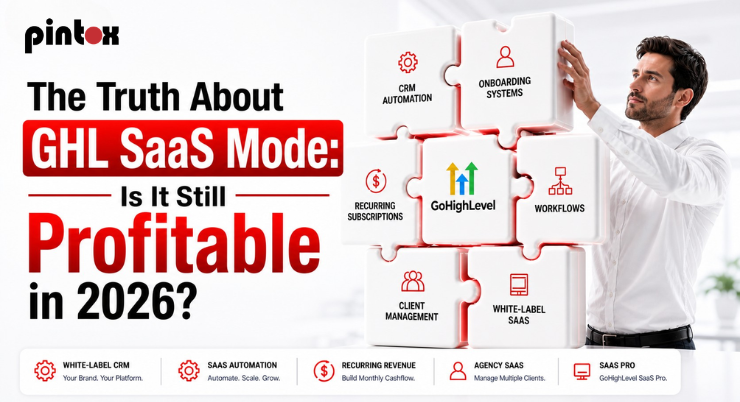
Everyone says SaaS mode is the holy grail. Here’s what they don’t tell you.
If you’ve spent more than ten minutes in any GoHighLevel Facebook group or YouTube rabbit hole, you’ve probably seen the screenshots. $30k MRR. Passive income. Sell software, not services. Build once, get paid forever.
And look, some of that is real. But a lot of it is cherry-picked. And if you’re sitting on the fence wondering whether GHL SaaS mode is actually worth your time and money in 2026, you deserve a straight answer, not a highlight reel.
So that’s what this is. No fluff. No income claims are designed to get you excited enough to click an affiliate link. Just an honest breakdown of what GHL SaaS mode actually looks like in the real world: the income potential, the real costs, what tends to go wrong, and whether it still makes sense to get into it this year.
Let’s get into it.
First: What Even Is GHL SaaS Mode?
If you’re newer to this space, quick context.
GoHighLevel is a marketing and CRM platform built specifically for agencies and service businesses. It handles everything: funnels, email, SMS, automation, reputation management, calendar booking, and more. Most agencies use it to run their own operations or manage client accounts.
SaaS mode is a feature within GoHighLevel that lets you white-label the entire platform and resell it as your own software product. You give it your own brand name, your own custom domain, and your own logo. Your clients never know it’s GoHighLevel underneath. To your customers, it’s your CRM, your software, your product.
You set the monthly price. GoHighLevel charges you a flat platform fee. The difference is your margin.
That’s the SaaS business model in a nutshell: you’re not selling done-for-you services anymore. You’re selling a software subscription that runs itself and getting paid every single month for it.
The GHL SaaS Mode Income Breakdown: What $10K/Month Actually Looks Like
Let’s talk real numbers. Here’s a case study from a local marketing agency that hit $10,000/month in recurring monthly income using SaaS mode GHL. It did this by selling to local businesses in their city. No massive audience. No viral content. Just a repeatable sales process and a white-label CRM that delivered real value.
The setup:
- Platform: GoHighLevel SaaS Pro plan (Agency Pro)
- White-label brand name: their own custom-branded CRM
- Niche: local service businesses — contractors, med spas, and chiropractors
- Pricing: $297/month per client
The math to $10K MRR:
Clients | Monthly Price | Monthly Revenue | GHL Platform Cost | Net MRR |
| 10 | $297 | $2,970 | ~$497 | ~$2,473 |
25 | $297 | $7,425 | ~$497 | ~$6,928 |
| 35 | $297 | $10,395 | ~$497 | ~$9,898 |
At 35 paying clients on a $297/month SaaS plan, you’re looking at just under $10K in software subscription revenue before any upsells or add-ons.
Here’s the thing about that platform cost: it doesn’t scale linearly. Whether you have 10 clients or 100 clients, your base GoHighLevel cost stays the same. That’s what makes the SaaS revenue model so attractive once you’re past 20–25 clients. The margins get really good, really fast.
If you want to run your own numbers before committing to anything, there’s a handy SaaS cost calculator that walks you through the exact breakdown based on your pricing and projected client count.
What Worked (The Honest Version)
1. The White-Label Angle Was Genuinely Powerful
Most local businesses don’t care what’s powering their CRM. They care that it works and that someone supports them when it doesn’t. Showing up with a branded CRM platform, a custom domain, and a polished onboarding experience made this agency look like they were running a proper software company. That perception translated directly into easier closes and better client retention.
GoHighLevel white label done right doesn’t look like GoHighLevel at all. And that matters when you’re selling to a dentist or a roofer who’s never heard of GHL.
2. Rebilling Automation Was a Game-Changer
One underrated part of high level saas is the rebilling feature. You can mark up the cost of SMS, email, and phone credits and charge clients for usage, and GoHighLevel handles the billing automatically. It’s not a massive revenue line on its own, but rebilling automation adds a few hundred dollars per month without any extra effort once it’s set up. It compounds nicely.
3. Selling to One Niche Made Everything Easier
The agency built one snapshot, one pre-configured, ready-to-go setup for med spas. Same automations, same pipelines, same campaigns, same onboarding checklist. Every new client took less than two hours to fully set up. That’s how you build a scalable SaaS business without hiring a team of five people.
When your GoHighLevel configuration is dialed in for a specific niche, you’re not starting from scratch every time. You’re just deploying the same thing again. Automated client onboarding becomes genuinely fast and low-stress.
4. The SaaS Onboarding Funnel Did the Selling
Rather than jumping on sales calls with every prospect, they built a SaaS onboarding funnel that walked people through the value, showed a demo, and handled the sign-up automatically. The saas high level plan paid for itself within the first two client closures, and the funnel kept running while they slept.
What Failed (This Is the Part Nobody Talks About)
1. Month One Was Brutal
Here’s the reality of agency recurring income: you don’t make money in month one. You spend it. Setting up the gohighlevel saas configurator, building your snapshot, creating onboarding materials, writing your SaaS pricing plans, setting up the custom domain, and building out your go high level saas offer. All of that takes real time and sometimes real money.
The agency in this case study spent about six weeks before they signed their first client. If you’re expecting a fast return, that timeline can feel demoralizing.
2. Churn Was Higher Than Expected in the First 90 Days
Early on, this agency signed some clients who weren’t the right fit. People who weren’t tech-comfortable. People who wanted someone to do everything for them, not just hand them software. Those clients churned within 60–90 days, which felt like punches to the gut when it was happening.
The fix was simple in hindsight: tighter qualification upfront and setting clearer expectations in the sales process. But it took losing four or five clients to figure that out.
3. Support was a real-time sink early on
When you’re reselling GoHighLevel as your own branded CRM platform, your clients come to you for support, not GHL. At 10–15 clients, that’s manageable. At 30+, it becomes a part-time job if you don’t have systems in place. Building out a knowledge base and FAQ library inside your branded portal early would have saved weeks of back-and-forth.
4. The GoHighLevel SaaS Configurator Has a Learning Curve
The GoHighLevel SaaS configurator, the system you use to set up your pricing tiers, feature toggles, and client access levels, is genuinely powerful, but it’s not the most intuitive thing in the world on your first pass. Plan for a few hours of trial and error. Watch the official GHL walkthrough videos before you touch anything live. The GoHighLevel configuration options are deep, and that’s both a strength and a source of early confusion.
What You’d Do Differently
If you were starting fresh with GHL SaaS mode today, here’s the short list:
Pick your niche before you build anything
Don’t build a generic snapshot and then try to sell it to everyone. Pick one type of business, understand their specific problems, and build your white-label SaaS around solving exactly those problems. The SaaS growth strategy that works is specificity, not breadth.
Price confidently from day one
A lot of people starting out with SaaS mode GHL underprice to get their first clients in the door. Then they’re stuck at $97/month trying to move to $297, and it creates awkward conversations. Start with what the value is worth and attract clients who see it.
Build your SaaS onboarding funnel before you start selling
Don’t improvise your SaaS client management process every time a new client signs up. Have the checklist, the welcome email sequence, the explainer videos, and the support docs ready before you close your first deal.
Know your actual costs
A lot of people jump into go high level SaaS without doing the real math. Between the SaaS Pro plan, any additional tools you keep running, software subscription costs for things you’re not replacing yet, and your own time, the margins can look thinner than the income screenshots suggest. Don’t skip the math step. Set up the GoHighLevel pricing breakdown in a smart way, just like Pintox has done.
Replace your other tools first
This one’s underrated. Most agencies sign up for GHL and keep paying for Calendly, Mailchimp, ActiveCampaign, ClickFunnels, and three other tools simultaneously. GHL replaces most, or all, of those, and that tool consolidation is often what makes the economics work. If you haven’t already looked at how much you can save if you replace expensive tools with GoHighLevel, that’s a genuinely useful exercise before you run your SaaS numbers.
Is GHL SaaS Mode Worth It in 2026?
Let’s be direct: yes, but not for everyone and not for the reasons most people sell it.
It’s not worth it if you’re looking for a get-rich-quick move. The SaaS profit margins are real once you scale, but getting to 30+ clients takes real effort, real sales conversations, real onboarding, real support.
It’s absolutely worth it if:
- You already have a small client base and want to add recurring monthly revenue on top of your service income
- You’re willing to niche down and build one really good snapshot for one specific type of business
- You understand that the ghl saas model requires patience for the first 60–90 days
- You want a scalable SaaS business where your revenue grows without your hours growing proportionally
The opportunity with high-level SaaS is still genuinely real in 2026. The market for local service businesses that need a simple, branded CRM, automated follow-ups, and a reputation management system hasn’t shrunk. If anything, more local businesses understand the value of this stuff now than they did two years ago.
And the competitive landscape? Most local businesses aren’t being sold GoHighLevel SaaS by someone who actually knows what they’re doing. That gap is still wide open.
If you want to see the full picture of what GHL can actually do before you decide, the real capabilities across every use case, this overview of GoHighLevel SaaS use cases is a solid starting point. It’s not a sales page. Just a clear breakdown of what the platform actually covers.
FAQ: GHL SaaS Mode in 2026
Is GHL SaaS Mode still profitable in 2026?
Yes, but the easy money days of “just launch it and leads will come” are over. In 2026, GHL SaaS mode rewards people who pick a niche, build a tight offer, and show up consistently. The recurring revenue model still works exceptionally well. You just need to earn each client now instead of riding a novelty wave.
What is GHL SaaS Mode, and how does it work?
GHL SaaS mode is a feature in GoHighLevel that lets you white-label the platform and resell it as your own branded CRM software. You set your own pricing, your clients see your brand, and GoHighLevel runs everything in the background. You pay a flat agency fee to GoHighLevel and keep the difference between that and what your clients pay you. The result is a SaaS revenue model built on top of someone else’s infrastructure.
How much money can agencies make with GoHighLevel SaaS Mode?
It depends on your pricing and the number of clients. At $297/month with 35 clients, you’re looking at roughly $10,000/month in software subscription revenue with profit margins of around $9,400+ after platform costs. Some agencies price higher and scale faster; others build slower and stay smaller. The ceiling on agency recurring income through GHL is genuinely high, but the floor requires patience to get off.
What are the monthly costs of running GHL SaaS Mode?
The GoHighLevel Agency Pro plan (which includes SaaS mode) runs $497/month at standard pricing. On top of that, you’ll want to budget for a custom domain, any external tools you haven’t replaced yet, and your own time for support and onboarding. Running through a SaaS cost calculator specific to your situation is the best way to get your real numbers.
Is GoHighLevel SaaS Pro worth it for agencies in 2026?
If you have at least 5–10 clients or a realistic plan to reach that number within 90 days, yes, the GoHighLevel SaaS Pro plan makes economic sense. If you’re starting from zero with no existing audience or client base, plan for a longer runway before you break even. The SaaS profit margins are excellent once you’re past 25 clients, but you have to get there first. Treat it like building a real business, not a side hustle, and the numbers work out well.
The Bottom Line on GHL SaaS Mode in 2026
GHL SaaS mode isn’t magic. It’s not passive income from day one. And it’s definitely not the overnight six-figure play that the YouTube thumbnails make it look like.
But it is a genuinely strong business model. One of the most legitimate ways of using GoHighLevel Services for a marketing agency or consultant to build predictable, scalable, recurring monthly revenue without hiring a big team. The white-label CRM market for local businesses is wide open, the platform is more capable than ever, and the agencies winning right now are the ones who got specific, got honest with their numbers, and built something real.
If that sounds like the version you want to build, GHL SaaS mode done right, with real support behind it, Pintox Digital works with agencies at every stage of the GHL journey. Reach out, and let’s figure out if this is the right move for where you are right now.
No hype. Just real help. That’s how we work at Pintox.