

You bought the software.
You designed the workflows.
You enabled the automations.
Why are leads still falling through the cracks?
It’s a common problem many business owners encounter after purchasing automation software, thinking that this solution will solve all their problems with efficiency, lead management, and revenue growth. However, they end up with lost opportunities and unfulfilled sales strategies.
The fact is that companies do not lack marketing automation; they lack a solid strategy for its implementation.
In this article, we’ll discuss some of the key issues associated with marketing automation software and, more importantly, their solutions.
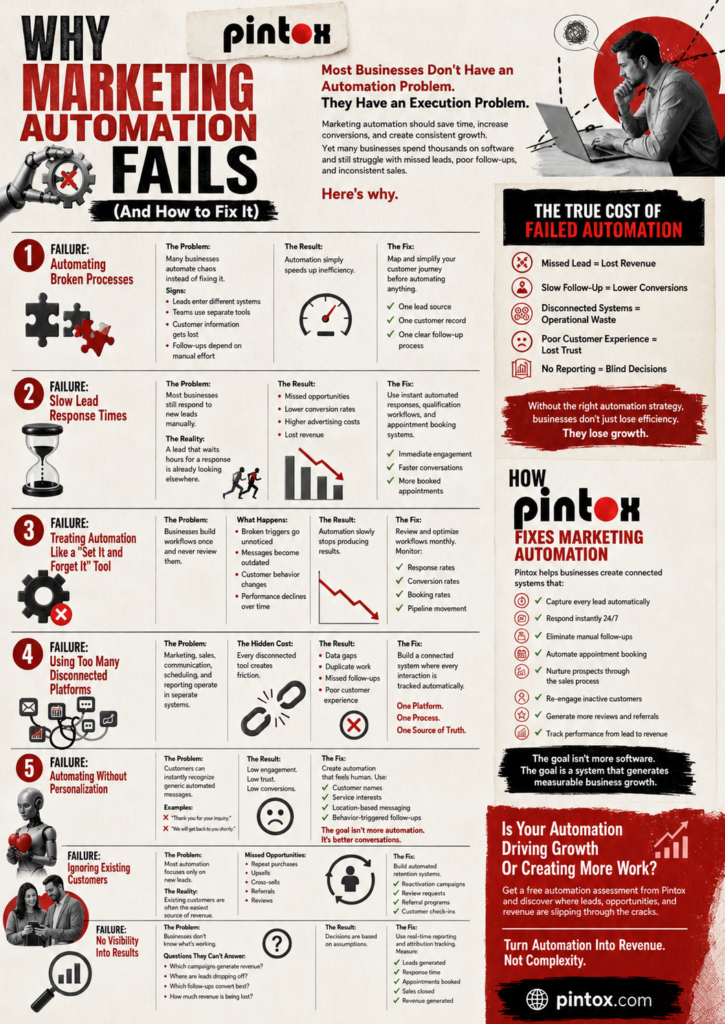
You’re Automating a Broken Process
The primary mistake that companies tend to make is relying on automation to resolve all their problems.
Think about how you receive a lead from your website. You get the information, transfer it to another software, and finally assign the lead to one of your employees. Now, if this process is already confusing, the automation will not help you because it will only speed up chaos.
But if you analyze your customer journey before automating, you will be able to see if your leads are monitored, answered, and followed up.
Good automation can only come out of good preparation.
Your Leads Wait Too Long for a Response
Let’s start off with an unpleasant truth: most leads will not just sit around waiting.
If a prospect submits a form or asks for more information, it means he or she contacts several companies at once. So if your message comes hours after their initial inquiry or even the next day, you are lagging behind.
It’s one of the toughest marketing automation challenges that a company may have to overcome. Fortunately, the solution is very straightforward: automatically answer their first email.
Your Messages Feel Robotic
Have you ever gotten one of those automated emails that read like something written by a computer?
Your clients do too.
Among the less well-known issues related to marketing automation is that of over-automation. Firms are so concerned with making things easier that they neglect the element of humanity.
Automation is meant to enhance your relations; not replace them. Use people’s names. Refer to what interests them. Make your communication personal according to their past actions.
Your Systems Don’t Talk to Each Other
Marketing, sales, customer service, and reporting applications are usually isolated silos.
The end result?
- Lost follow-throughs.
- Multiple entries.
- Disoriented staff.
- Irritated clients.
One of the most exasperating difficulties associated with marketing automation involves managing disparate systems. Dispersed information means missed chances. A connected system guarantees everything is captured.
You’re Not Measuring What Matters
Companies start their automation processes and forget about them completely.
After months, they find themselves asking why things haven’t started improving yet.
Optimization is key in automation. If you are not monitoring how quickly leads respond, conversion rates, scheduled meetings, and generated revenue, you are simply guessing. The most successful automation strategies are constantly evolving.
How to Make Marketing Automation Actually Work
These are some of the typical challenges that many companies experience when implementing marketing automation. But don’t worry – they are all fixable, especially with the proper implementation approach.
Start by streamlining processes first, then automate. Communicate with leads immediately. Make communication personalized. Integrate your solutions. And above all, keep tracking performance metrics.
This is exactly what we do at Pintox. We specialize in helping companies set up automation systems that do more than just save time. They streamline communication, generate more leads, and increase conversion.
It’s not about using more technology. It’s about increasing profits. And marketing automation does precisely that.