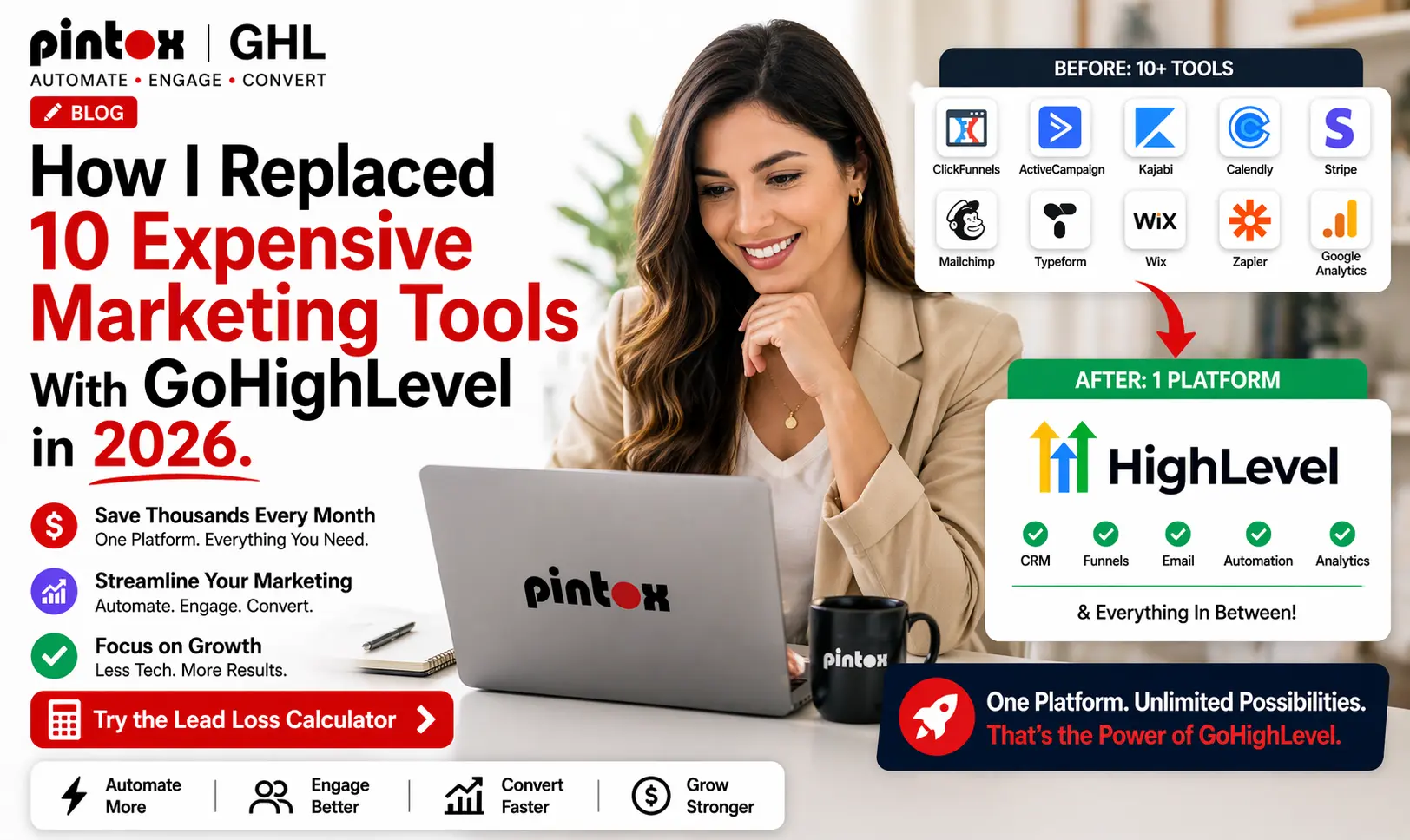
$1,847/month to $297/month. But there’s a catch nobody tells you about.
If you are running an agency or a small business in 2026 and you are still paying for a separate tool for every single function in your marketing stack, you already know something is wrong. You feel it every time you log into the fourth platform before 9 am. You feel it when a lead falls through the cracks between your CRM and your email software. You feel it most acutely when you finally sit down and add up every marketing tool subscription you are paying for, simultaneously.
I did that math in January 2026. The number was $1,847 per month across ten different marketing tools. Each one had made sense when I added it. Together, they had become a fragmented, expensive, exhausting system that no single person on my team fully understood.
Switching to GoHighLevel brought that number to $297 per month. One login. One database. One platform where everything actually connects.
But I promised a catch, and here it is: the migration is a real project. Expect 60 to 90 days of running both systems simultaneously, rebuilding automation workflows from scratch, and retraining your team. Nobody in the GHL content world talks about that part with any honesty. I am going to, because I think you deserve an accurate picture before making any decisions about your marketing tools.
Here is the full breakdown. Every tool. Honest verdicts. Including where GoHighLevel still loses.
The Real Reason My Agency Software Stack Had to Go
I had been adding tools to my stack for three years without ever auditing the whole thing. Each addition felt justified at the time. Better email marketing automation here. A dedicated landing page builder is there. Review management software for a client that we ended up keeping for ourselves.
The breaking point was not the cost, though the cost was high. It was a moment with a new hire on her third day. She needed to pull up a lead’s full history before a sales call. That information was scattered across four platforms: the CRM for contact notes, the email marketing software for communication history, the booking tool for appointment records, and a separate SMS marketing tool for text conversations.
Six minutes later, she had the full picture. The lead had been waiting on hold the whole time.
That is not a tool problem. That is a fragmented system problem. No amount of workflow automation through Zapier was going to fix it permanently, because the fundamental issue was that our data had no single home. We had a client management system built out of duct tape and API connections rather than a centralized marketing system designed to work as one.
That is when I started seriously evaluating GoHighLevel, not as another tool to add to the stack, but as a replacement for all of it.
What GoHighLevel Actually Does as a Platform
Before the breakdown, some context for anyone who has not used it. GoHighLevel is a business automation platform and all-in-one marketing platform built specifically for agencies and small businesses. It combines CRM and marketing software, email and SMS automation, funnel building, appointment booking, reputation management, course hosting, web chat, social scheduling, and workflow automation into one natively integrated environment.
The Pro plan costs $297 per month. For agencies managing client accounts, the SaaS mode allows you to white-label the platform entirely, which changes the economics considerably. But for this piece, we are focused on the consolidation math.
The Numbers That Changed Everything: Full Cost Comparison
Here is every marketing tool I replaced, what I was paying, the market range, so you can find your own number, and an honest verdict on GHL’s equivalent.
Tool | Function | My Cost | Market Range | GHL Coverage | Verdict |
| ActiveCampaign | Email automation, CRM | $179/mo | $93–$386/mo | Email workflows, pipeline CRM | Full replacement for most agencies |
ClickFunnels | Funnel and page builder | $297/mo | $97–$297/mo | Funnel builder, websites, order forms | Full replacement except for very complex custom designs |
| Calendly | Appointment booking | $20/mo | $10–$60/mo | Calendar, round-robin, reminders | Clean full replacement |
Klaviyo | Email and SMS marketing | $230/mo | $45–$400/mo | Email and SMS campaigns, tagging | Partial: full for service businesses; keep for e-commerce |
| HubSpot CRM | Pipelines, contacts | $450/mo | $45–$300/mo | Full CRM, pipelines, records | Full replacement under 50 active clients |
Zapier | Workflow automation | $99/mo | $20–$99/mo | Native automation across all features | Near-full replacement |
| Podium | Review management | $299/mo | $249–$399/mo | Review requests, AI replies | Excellent full replacement |
ManyChat | Chat and DM automation | $65/mo | $39–$149/mo | Web chat, AI chatbot, social DMs | Full replacement for lead generation |
| Kajabi | Courses, memberships | $119/mo | $49–$199/mo | Course builder, membership portal | Partial: works for most; keep if courses are core |
Buffer | Social media scheduling | $89/mo | $18–$99/mo | Social planner, scheduling | Full replacement for most agencies |
| Total | $1,847/mo | $665–$2,388/mo | |||
GoHighLevel Pro | Everything above | $297/mo | $297/mo | Save $1,550/mo ($18,600/yr) |
That last row is a real number, not a cherry-picked scenario. But the Verdict column is where I want you to spend your attention, because two of those tools get a “Partial” rating for a real reason, and understanding why matters before you pull the trigger on anything.
Breaking Down Every Marketing Tool: What Actually Happened When We Switched
ActiveCampaign: Three Years of Sequences, Gone in Three Weeks
ActiveCampaign was the hardest tool to walk away from emotionally. We had years of marketing automation workflows built inside it, complex conditional branching, lead scoring, and a tagging architecture our whole team had learned to navigate.
GHL’s email marketing automation is genuinely strong. The visual workflow builder handles the logic that covers the vast majority of what agencies actually need from marketing automation tools. The native connection to the CRM means a contact’s email behavior and pipeline stage live in the same record, which eliminates one of the most common sources of data fragmentation in a multi-tool stack.
Where ActiveCampaign maintains an edge is in managing very large lists with sophisticated behavioral scoring across 100,000 or more contacts. For agencies under 25,000 contacts, which covers most growing agencies, GHL is a full like-for-like replacement.
The migration revealed something useful: half of our ActiveCampaign sequences had not triggered in over a year. The audit was clarifying.
ClickFunnels: Our Funnels Survived the Move (Mostly)
Honestly, GoHighLevel vs. ClickFunnels was a tough pick for me. The team pushed back hardest on replacing ClickFunnels. We had a lot of funnels in there and real anxiety about the rebuild.
GHL’s funnel builder handles standard lead generation funnels, webinar registration flows, and appointment booking sequences as well as ClickFunnels does. The template library is smaller. If your entire brand identity depends on highly custom, visually intricate sales page design, you will feel the difference in design flexibility.
For everything else, which is the majority of what most agencies actually use a sales funnel builder for, GHL is a full replacement. Our conversion rates on rebuilt funnels were within two to three percent of the originals within 30 days.
Rebuilding the funnels was the most time-intensive part of the entire migration. Budget four to six weeks of part-time work.
Calendly: The Easiest Win in the Entire Migration
GHL’s appointment booking system handles everything. Calendly does and then some. Round-robin assignment across team members, multi-calendar routing by service type, automated pre-appointment SMS and email reminder sequences, and post-appointment follow-up workflows. All native. No integration layer required.
We rebuilt every calendar link and routing logic in about two hours. It was the most painless replacement on the entire list and one I genuinely wish we had made earlier.
Klaviyo: The Honest Answer Depends on Your Business Model
Klaviyo deserves the most careful treatment here, because the right answer really does depend on what your business does.
If you are running a service-based business or an agency using Klaviyo for email campaigns, broadcast newsletters, and nurture sequences, GHL replaces it cleanly. The email builder, contact segmentation, and campaign analytics cover everything a service business needs from an email marketing software platform.
If you are running e-commerce with Shopify, using Klaviyo’s purchase-behavior triggers, product-specific sequence branching, and revenue attribution, GHL is not a like-for-like replacement for those specific functions. Klaviyo’s e-commerce depth is best-in-class for that use case and worth the cost.
We are a service business. For us, it was a full replacement with no meaningful loss.
HubSpot CRM: The Most Expensive Swap and the One With the Most Skepticism
HubSpot was our most expensive single subscription and the one that generated the most internal resistance when I proposed replacing it.
GHL’s CRM and marketing software combination handles agency-scale operations well. Pipeline management is clean. Contact records pull in every communication touchpoint natively. Custom fields, deal stages, and contact tagging all work. Basic reporting covers what most agency owners actually look at week to week.
Where HubSpot still leads is in enterprise-level reporting depth, custom object architecture, and the breadth of third-party integrations that large sales organizations and RevOps teams depend on. If you have a dedicated CRM administrator managing complex reporting dashboards and custom objects, HubSpot’s depth is genuinely superior.
For agencies with under 50 active clients and teams of under 20 people, GHL handles the CRM function completely. All in all, GoHighlevel vs. HubSpot actually depends on your demands and requirements.
Data migration via CSV export and import took about a day. Rebuilding pipeline stages and custom fields took another.
Zapier: 47 Zaps Down to 4
Replacing Zapier was one of the most satisfying parts of the entire migration. When your digital marketing tools all live inside one platform, most of what a workflow automation layer was doing becomes unnecessary. The connections that required middleware now happen natively.
We went from 47 active Zaps to 4. The 4 remaining ones connect GHL to external tools we still use for specific client work. The other 43 were automations between tools that are now all inside GHL.
Beyond the subscription cost, the reliability improvement was significant. Workflow automations between tools break. They break quietly. You find out three days later that a lead who should have been entered into a nurture sequence never got the first message. Native workflows inside a single platform do not have that failure mode.
Podium: The Replacement That Paid for GHL All By Itself
We were paying $299 per month for Podium to do one primary thing: automatically request Google reviews after a job completion and manage the reply workflow.
GHL’s reputation management does exactly this. Automated review request sequences via SMS and email, AI-suggested smart replies for incoming reviews, and a unified dashboard. The functionality is genuinely comparable.
For any agency managing reputation for local business clients, the Podium replacement alone saves more per month than GHL costs. That math is the clearest financial argument for the switch.
ManyChat: Lead Generation Chat Replaced Without Issues
ManyChat was handling website chat lead capture and Facebook and Instagram DM automation. GHL’s web chat widget and social DM automation tools cover both for lead generation purposes cleanly.
Where dedicated platforms like enterprise-tier Intercom still lead is in complex customer support with integrated ticketing systems. For lead capture, appointment booking via conversation, and FAQ automation, GHL handles it without compromise.
Kajabi: The One I Will Not Oversell
GHL’s course builder works. It is adequate. But Kajabi’s course and community experience is more polished, the student interface is better designed, and the community features are more fully developed.
If your primary revenue model is selling online courses or memberships and the quality of that learning experience is central to your brand, Kajabi’s polish has real value. Keep it.
If courses are a secondary offer or a lead magnet for a service business, GHL’s version is completely adequate. We kept Kajabi for one client whose entire business is a membership community. For our own lead magnets and mini-courses, we moved to GHL without issue.
Buffer: The Quietest Replacement on the List
GHL’s social planner handles scheduling across platforms, content calendar management, and basic performance metrics. For agencies scheduling their own content and handling basic client social posting, it is a clean full replacement.
If social media management is your core service offering and your clients require deep analytics and competitor tracking, a dedicated social tool remains worth maintaining. For most agencies where social posting is one component of a broader service, GHL handles it completely.
Where GoHighLevel Still Loses (Read This Before You Switch)
This section is the one that matters most for your decision, and it is the one most GHL content skips entirely.
E-commerce marketing depth
If your business runs on Shopify with Klaviyo-style purchase-behavior segmentation and revenue attribution, GHL is not the right email marketing software for that specific function. The gap is real and meaningful for e-commerce businesses.
Enterprise CRM capabilities
Salesforce and HubSpot Enterprise have custom object architecture, advanced pipeline reporting, and integration breadth that large sales organizations depend on. GHL is an excellent CRM and marketing software combination for agencies and SMBs. It is not an enterprise CRM.
Course platform design quality
Kajabi’s learning experience design is more polished. If that polish is central to your product, the subscription cost is justified.
The migration window
This is the catch from the opening. Running parallel systems for 60 to 90 days while rebuilding automation workflows, migrating contact data, and retraining your team is real operational overhead. It requires someone accountable for managing the project, a realistic timeline, and genuine leadership commitment. Go in expecting a seamless overnight switch, and you will be frustrated. Go in with a proper plan, and it is entirely manageable.
Niche industry integrations
If you depend on a highly specific integration for your industry that GHL does not natively support, verify before committing. Some niche connections still require a lightweight external automation bridge post-migration.
What Changed Beyond the Monthly Software Costs
The $1,550 monthly savings is the number that gets attention. Twelve months later, it is not what I talk about most.
What I talk about is the Tuesday morning when that same hire needs a lead’s full history before a call. One screen. Everything is there. The conversation history, the emails, the appointment records, the pipeline stage, and the notes from the last interaction. Thirty seconds, not six minutes.
I talk about leads that stopped falling through the cracks because there are no longer any gaps between tools for them to fall into. The subscription management overhead of twelve separate platforms collapsed into one renewal, one support contact, and one system for the team to understand.
I talk about onboarding new hires to one business automation platform instead of twelve. What used to take two weeks now takes two days.
The cost savings recovered the migration effort within the first month. The operational improvement is something we are still compounding a year later.
Frequently Asked Questions
What tools can GoHighLevel replace?
GoHighLevel is built to function as a complete all-in-one marketing platform, replacing separate tools for CRM and pipeline management, email marketing automation, SMS marketing tools, appointment booking, landing page and funnel building, reputation management, web chat and chatbot automation, course and membership hosting, social media scheduling, and marketing automation workflows. For most agencies and service-based businesses, it consolidates 8 to 12 separate tools into one centralized platform. So, it would be a difficult task to find matching GoHighLevel alternatives.
Is GoHighLevel software better than using multiple marketing tools?
For most agencies and service-based businesses, yes. The advantage is not only the reduction in monthly software costs, though the savings are substantial. It is that native integration between features eliminates the data fragmentation, workflow gaps, and automation maintenance burden that comes with running multiple disconnected digital marketing tools. The exceptions are businesses with heavy e-commerce requirements, enterprise-scale CRM needs, or course platforms where design quality is a core part of the product.
How much money can you save with GoHighLevel software?
It depends entirely on your current stack and what you are paying for each tool. Based on market averages for the ten most common agency tools, typical savings range from $368 per month on the low end to over $2,000 per month for agencies on premium tiers of multiple platforms. The most accurate way to see your specific number is to use the software calculator, which calculates your savings based on your actual subscriptions.
Can GoHighLevel replace CRM and email marketing tools?
Yes, and this combination is one of GHL’s clearest strengths. The GoHighLevel CRM marketing automation works together natively, meaning a contact’s pipeline stage, email history, and communication record all live in one place. For agencies and service businesses, this eliminates one of the most common sources of lead leakage: contact data that exists in the CRM but is out of sync with the email marketing software, or vice versa.
Is it hard to switch from multiple tools to GoHighLevel?
More honest than most answers you will find: it is a real project. Expect 60 to 90 days to fully migrate a mid-size agency stack. The most time-intensive parts are rebuilding marketing automation workflows, migrating contact data, and getting your team comfortable with a new system. The complexity scales with how many tools you are replacing and how sophisticated your existing workflows are. Pintox Digital offers a free Stack Audit that maps out exactly what your migration would look like before you commit to anything.
The Smartest Move You Can Make With Your Marketing Tools Right Now
GoHighLevel is not a perfect platform. I have been direct about where it falls short, and those limitations are real for the right business types. But for the majority of agencies and service-based businesses evaluating their marketing tools in 2026, GoHighLevel services are the most significant operational and financial improvement available through a single decision against all GoHighLevel competitors.
The cost reduction is real. The workflow consolidation benefit is real. The reduction in overhead from managing a fragmented agency software stack across twelve separate subscriptions is real. And the improvement in team productivity that comes from having every customer communication tool, every pipeline stage, every automation, and every piece of contact data in one centralized system is something that compounds every single week after the migration is complete.
The migration takes genuine work. Go into it with a plan, with someone accountable, and with realistic expectations about the 60- to 90-day timeline. The payback starts in month one.
If you want to see what your specific numbers look like before making any decisions about your marketing tools, start with the calculator. If the savings figure is significant, the next step is a free stack audit with Pintox. We will tell you exactly what to keep, what to cut, and what your migration plan looks like for your specific business. No pressure and no pitch, just the information you need.