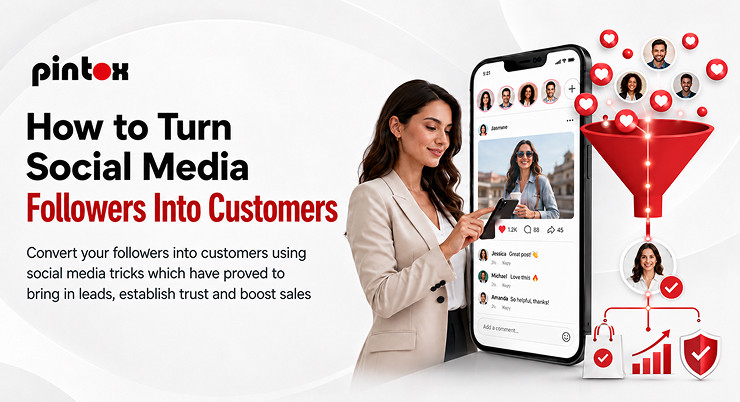
All companies want to have many followers on social media. A larger audience sounds good and can help to grow visibility and create opportunities to reach even more potential customers. But followers do not make money on their own. The power of social media marketing lies in converting followers into customers of the product or service of the company.
Many companies spend weeks and months making content, regularly publishing it, developing an audience, but see that sales do not increase at all. The thing they miss is not gaining new followers. They need to develop the right strategy of conversion of followers on social media.
No matter whether you are the owner of a small business, service provider, eCommerce company, or a B2B brand, understanding how to convert followers into customers is not just about creating good-looking posts. You should build trust with potential customers, educate them, make an interaction, and use smart systems for moving potential buyers.
This guide will teach you useful, tested strategies for converting followers into customers and improving your social media marketing strategy.
Why Followers Don’t Always Become Customers
Among the largest misconceptions in digital marketing is the idea that having many followers will automatically generate income. However, in reality, that does not occur very often.
There are various reasons why people follow businesses on social media platforms. Some people like learning from them, others appreciate entertainment, while some like keeping up with industry trends. The fact of the matter is that people are exploring their options before deciding to buy.
That is the reason why businesses need a proper social media customer journey map rather than expecting quick purchases.
There are several common reasons why businesses do not manage to transform their social media engagement into sales:
- Posting promotional material too often
- Never ask followers to do anything further
- Redirecting followers to low-quality websites
- Not responding to any comments or messages
- Not nurturing leads
- Lack a follow-up procedure
To help businesses solve the problems mentioned above, they need to know about the buyer journey. Prior to purchasing something, most buyers go through several steps:
- Discover your business
- Understand your field
- Boost confidence in your brand
- Evaluate your choices
- Make a purchase
Those who know about the stages of this process acquire customers more efficiently on social media since they concentrate on leading the way rather than driving the audience.
1.Earn Customers’ Trust First
People tend to buy from companies they trust.
Asking for sales on each post will eventually make followers disengage. You have to provide people with information showing that your business is experienced, trustworthy, and able to solve their problems.
Building confidence starts with consistency.
Provide educational posts answering common questions. Explain the market trends in an understandable way. Share the behind-the-scenes content introducing your team. Provide success stories showing the results achieved. Social proof is one of the best trust-building factors.
Positive customer feedback, testimonials, and results, before and after statements, will make the potential buyers believe in your services.
One more effective way is replying to comments and direct messages as quickly as possible. Engaging in conversations helps you establish relationships and sell better.
Consistently providing customers with trustworthy information makes selling much easier since people trust you from the beginning.
2. Create Content That Solves Problems
People do not convert into customers through a sales message.
They convert when your content shows time and again that you can understand their problems and offer them workable solutions.
Your content marketing strategy should solve problems your audience might already be trying to solve.
Some possible ideas include:
- Guides on education
- How-to videos
- Industry tips
- Frequently asked questions
- Success stories from customers
- Mistakes to avoid
- Product demonstrations
Education-based content makes your company look like a specialist and engages with the audience as well.
It is important to know about the 80/20 ratio here, which means that 80 percent of the content should be educational, informative, and entertaining, whereas only 20 percent of the content should be about making sales.
For example:
Instead of saying,
“Our CRM software is the best.”
Tell them,
“Five reasons why businesses lose leads and how CRM prevents that.”
This way of content writing will help your business in lead generation from social media platforms because your company is seen as a source of information rather than just another advertiser.
3.Include Effective Calls-to-Action
Even the most engaged followers would not do anything if they don’t get any instructions. It is here that the value of the call-to-action becomes evident.
Each piece of content should urge the reader to make a single step.
Some examples of the steps are:
- Download the free guide
- Book a consultation
- Get a quote
- Arrange a demo
- Read the blog
- Watch a webinar
- Send a message
- Subscribe to emails
The call-to-action should seem more like an offer to help and not to pressure the client.
Do not write such messages as
“Buy now.”
Write like,
“How will this solution help your business?”
The small change in wording could greatly improve the conversion rate on social media as the clients already know what action to take.
Just keep in mind that each piece of content should promote your overall sales funnel on social media.
3. Drive Follower Traffic to Landing Pages that Convert Well
One of the main reasons why businesses are unable to convert the followers to customers is by directing them to the homepage where there are too many distractions.
Landing pages will do better since they have one purpose only.
Some of the characteristics of good landing pages include:
- An effective headline
- A simple explanation of your offer
- Customer testimonials
- Good social proof
- Benefits rather than features
- Contact forms
- Call to action (CTA)
Not having any extra navigation helps increase the rate of conversion on your website because the visitor only has one thing to focus on.
No matter whether you want to generate leads, appointments, or sales, landing pages are very important in the conversion of your social media marketing efforts.
4. Capture Leads Rather Than Just Waiting for Them to Make Sales
All visitors might not be ready to make a sale at this point in time. But this doesn’t mean that they can’t be converted into leads.
Instead of expecting them to buy from you right away, entice them to exchange their details in return for something worthwhile.
Some common lead magnets are:
- Free checklist
- Industry report
- Templates
- eBook
- Webinars
- Free consultations
- Discounts
With this approach, you can get leads from social media channels but keep the conversation going. After the person provides their contact details, they can be nurtured as your leads.
Lead nurturing is an effort to establish familiarity rather than having one-off engagement with the visitors. Companies that are always able to capture leads do better than others.
5. CRM Automations For Follow-Ups
Businesses often miss out on sales simply because they do not follow up. People get busy. Things happen. What was once a promising lead yesterday may not be the same today.
Here is when you need CRM automations.
Modern CRMs help in managing leads, communication, and even automating conversation within the entire sales pipeline.
Businesses looking into social media marketing for small businesses will benefit from this automation process since it saves time and increases consistency in the process.
GoHighLevel CRM will allow you to:
- Reply to leads
- Send out welcome emails
- Provide lead magnets
- Schedule meetings
- Create follow-ups
- Send reminders
- Record customers’ activities
Automating marketing makes sure that there are no missed leads. You can even add some personal touch to it with the use of personalized messages.
Other tools like AI chatbots will help you reply to most of the inquiries in an instant, while scheduling meetings through social media will shorten the sales cycle.
Efficient automated follow-ups will keep your business in touch with its prospects until they are ready to make a purchase.
6. Retargeting Engaged Followers
Not everybody makes purchases on their first engagement. In most scenarios, people need multiple engagements before making purchasing decisions.
That is why retargeting helps stay connected through all stages of the purchasing journey.
With the help of retargeting ads, you are able to connect to people who:
- Have visited your website
- Have watched your videos
- Have interacted with your content
- Have opened your lead magnets
- Have filled contact forms
- Have visited pricing pages
Instead of engaging with everyone, retargeting helps connect with people who already know about you.
Using retargeting together with follow-ups via email and CRM automations is a great way to engage and convert people.
If you are searching for ways to find customers using social media, then retargeting is one of the best marketing decisions you can ever make.
7. Measure Your Social Media Conversion Rate
You can’t optimize something you aren’t measuring.
Many companies pay attention to social media followings, likes, and comments but neglect the metrics that make an actual difference for the bottom line.
An effective social media conversion strategy should pay attention to such important performance indicators as:
- Social media traffic to website
- Conversion rate on landing page
- Lead generation
- Appointment scheduling
- Conversions
- Cost per lead
- Customer acquisition cost
- Customer lifetime value
Notice where potential clients join your funnel and where they stop being interested.
In addition, it’s worth watching how you qualify leads since it is important not only to attract a lot of people but also those who would really like to purchase your product.
Conversion rate optimization requires A/B testing of various headlines, calls-to-action, landing pages, images, and messaging.
Small changes may bring significant improvements in terms of revenue without any expenses on advertising.
Last but not least, don’t forget about customer retention, which may be more effective and lucrative than lead generation. Keep in touch with the already purchased clients.
Frequently Asked Questions
How do I turn my social media fans into paying customers?
Through consistently providing value through content marketing, developing trust, using strong call-to-actions, lead generation and follow up through e-mail marketing or CRM marketing.
Why do I have fans but not sales?
Because most businesses try to accumulate fans rather than guide them through a customer journey that involves offer pages and follow up.
What is the best social network for conversions?
The best social network depends on your specific market, but LinkedIn works great for B2B and Instagram & Facebook work for many B2C.
Should I implement a CRM system to manage social media leads?
Yes, as this will assist in organizing leads, automating the follow up process and maximizing conversion rates through not overlooking any prospect.
How important are landing pages in social media marketing?
Landing pages are very important as they give a specific place where visitors can take some action rather than being distracted.
Can automation assist in converting social media visitors?
Yes, automated follow ups, lead nurturing and appointment reminders contribute towards quicker conversion of prospects.
Which kind of content brings maximum customers?
Educational, customer success stories, demonstration and problem solving content bring maximum customers.