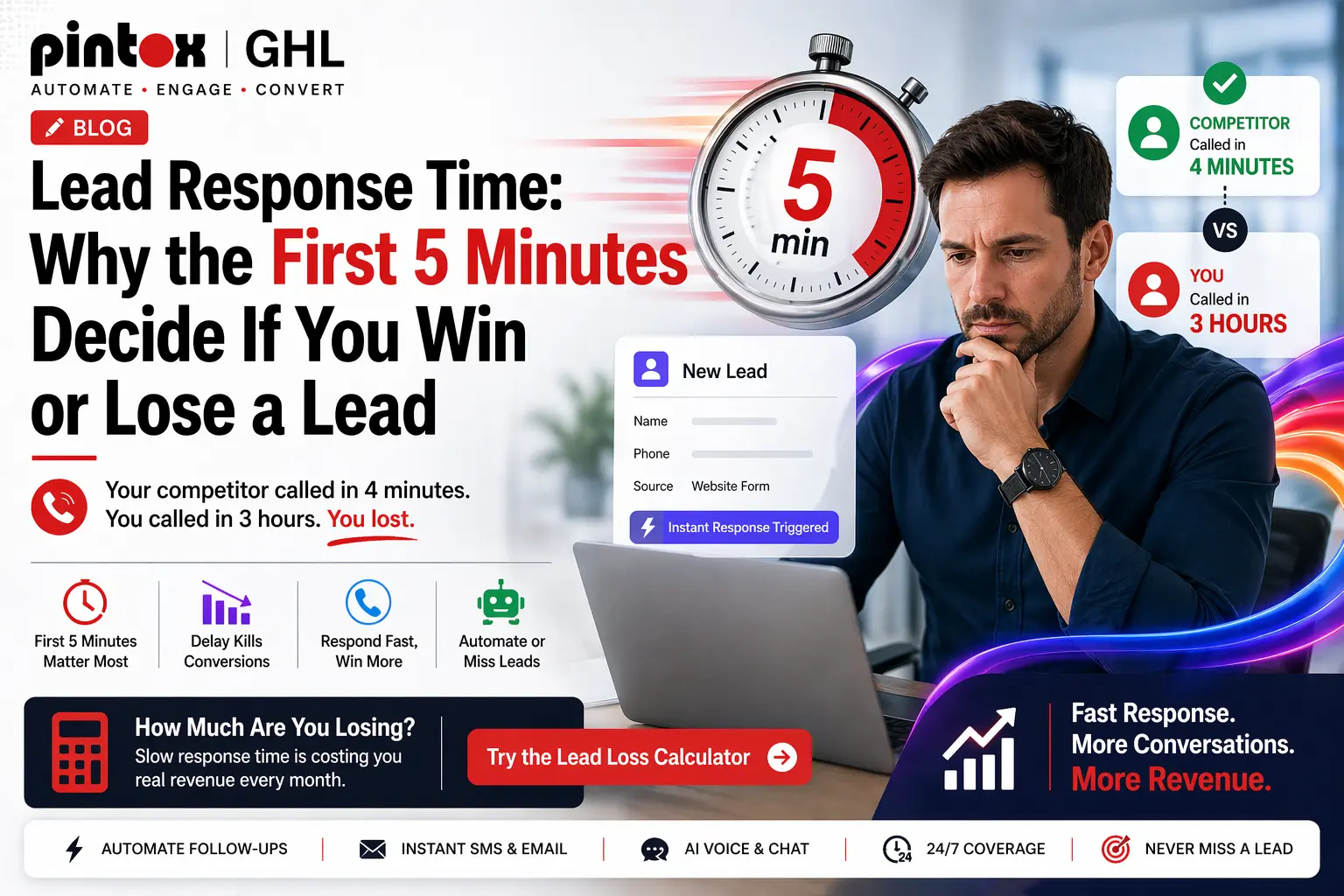
Your competitor called back in 4 minutes. You called in 3 hours. You lost and didn’t even know it.
There is a lead sitting in your CRM right now that you will never close. Not because your offer was wrong. Not because your price was too high. Not because the timing was bad. You will lose it because by the time someone on your team picks up the phone or fires off a reply, that person has already heard back from someone else, filled out their form, and moved on.
Inbound lead response time is the single most decisive factor in whether an inbound lead converts or disappears. The research on this has been consistent for years, and the numbers are not subtle. Leads contacted within five minutes of submitting a form are dramatically more likely to convert than leads contacted after 30 minutes. After an hour, the odds drop so significantly that many sales teams are effectively working a dead list without knowing it.
Most business owners have no idea this is happening to them. Their conversion rates look low, and they blame the ad creative, the landing page, the offer, and the market. The actual problem is sitting in their response time data.
Before we go any further, use this lead loss calculator to see lead response time stats and how it is costing your business specifically.
Input your monthly lead volume and your average response time. The number that comes back is not an estimate. It is the revenue your business is losing every single month because of the gap between when a lead raises their hand and when someone on your team reaches back.
Now let’s talk about why this happens, what the data actually says, and how GoHighLevel’s automation infrastructure fixes it permanently.
The Silent Killer of Inbound Lead Generation Funnels
Most businesses have invested real money in their lead generation advertising. They have optimized their landing pages. They have built their lead generation funnels carefully. They are paying for traffic, nurturing audiences, and running retargeting campaigns. And then a lead comes in at 2:17 pm on a Wednesday and sits untouched until 9:00 am Thursday because the sales rep was in back-to-back meetings and nobody had a protocol for coverage.
That lead is gone. Not maybe gone. Gone.
The problem is structural, not personal. In a typical business without automated lead response systems, inbound leads flow into a CRM or an email inbox and wait for a human being to notice them, prioritize them, and act. That process introduces hours of delay as a baseline. On evenings, weekends, and holidays, it introduces days.
Meanwhile, the lead has not stopped moving. They submitted a form because they were ready to buy something. That buying intent is not patient. Research consistently shows that consumer expectations around response time have compressed dramatically in recent years. People who fill out a contact form in 2026 expect to hear back within minutes, not hours. When they do not, they do not wait. They move to the next result on Google and fill out another form.
Your lead generation budget just funded your competitor’s new client.
This is the core of the lead engagement problem for most growing businesses. It is not a sales skill issue. It is a speed issue, and speed at that scale requires automation.
What the Data on Lead Response Time Actually Says
The most cited study on this subject, conducted by the Harvard Business Review in partnership with a group of US companies across industries, found that companies contacting leads within one hour were seven times more likely to have a meaningful conversation with a decision-maker than those who waited two hours. Companies that waited 24 hours were sixty times less likely to qualify as a lead at all.
More recent data from sales intelligence research puts the optimal window even tighter. Leads contacted within five minutes of form submission convert at rates that are exponentially higher than leads contacted after 30 minutes. By the time you reach the one-hour mark, you are looking at conversion rates that have declined by more than 80 percent compared to the five-minute benchmark.
That is not a marginal difference. That is the difference between a functioning lead funnel and an expensive traffic machine that produces very little revenue.
For local service businesses, the numbers hit differently because the competition is immediate and local. When someone searches for a plumber, an HVAC company, a dental clinic, or a law firm and fills out a contact form, they have almost certainly submitted that same form on two or three competitor websites simultaneously. The business that calls or texts first wins the appointment. The others get voicemail and a polite “we went with someone else.”
Speed to lead is not a nice-to-have in 2026. It is the determining factor in inbound lead generation opportunities and lead generation customer service outcomes for most local and service-based businesses.
Why Manual Follow-Up Will Always Lose the Speed Race
The instinctive response to this data is to tell your team to respond faster. Set a policy. Require leads to be contacted within 15 minutes. Monitor compliance. Add it to performance reviews.
This does not work at scale, and here is why.
The five-minute window that produces the highest lead qualification rates is not achievable through manual processes for any business receiving more than a handful of leads per day. It requires someone to be actively watching for new form submissions at all hours, including evenings, weekends, lunch breaks, and every other moment when your team is unavailable. It requires that person to drop whatever they are doing the instant a lead comes in and immediately engage.
That is not a system. That is a hope.
Real customer lead management at the speed the data recommends requires automation. It requires a workflow that triggers the moment a lead submits a form and initiates outreach before a human being has even seen the notification. Not minutes later. Seconds later.
This is exactly the problem that GoHighLevel’s automation infrastructure was built to solve. GoHighLevel automation hacks is a collection of tips and tricks and covers the specific workflow configurations that make instant outreach possible.
How GoHighLevel Solves the Lead Response Time Problem
GoHighLevel approaches lead response time as a systems problem with a systems solution. The platform’s automation workflows can be configured to trigger an immediate multi-channel outreach sequence the instant a lead enters the system, regardless of what time it is, regardless of whether anyone on your team is at their desk.
Here is what that looks like in practice
A lead submits a form on your website at 11:43 pm on a Saturday. Within seconds, GHL’s automation workflow fires. The lead receives an SMS message acknowledging their inquiry and asking a qualifying question. Simultaneously, an email goes out with relevant information about the service they enquired about. If you have configured an instant outbound call feature, a call can be initiated within 60 seconds,, connecting your on-call team member directly to the live lead. If nobody answers on your end, the system logs the attempt and queues the next touchpoint automatically.
When your sales rep shows up on Monday, the lead is not cold anymore. They have already received a few messages, been sorted inside the CRM, and placed in the right queue based on how interested they seem. That means your team is not starting from zero or digging through a pile of random new contacts.
Even if the lead came in late on Saturday night, your system has already been working in the background. It has kept the conversation going while your team was away. So by Monday morning, that person already feels noticed. They do not feel like they were left waiting all weekend. And when your rep reaches out, the conversation feels much easier. That is the real value of speed-to-lead workflow.
It is not just about the first message. It is about the entire automated sequence that runs from first contact to human handoff, designed to keep the lead engaged and qualified at every step.
The Missed Call Text-Back: The Simplest Win in Lead Nurturing Strategies
Before we get into the full automation architecture, there is one GHL feature that deserves its own section because it solves one of the most common and most expensive lead leakage problems for local businesses: the missed call.
When a lead calls your business, and nobody answers, what happens? In most businesses, nothing. The lead hangs up, assumes you are busy, and calls your competitor. You never even know they called, or if you do know, you call back two hours later when they have already booked with someone else.
GHL’s missed call text-back feature triggers an instant SMS to any number that calls and does not get answered. The message goes out within seconds of the missed call, acknowledging that you missed them, telling them you will call back shortly, and often asking a qualifying question to start the conversation.
The impact of this single feature on lead engagement metrics is significant. A lead who calls and gets no response is a lost lead. A lead who calls, gets no answer, and immediately receives a text saying “Hi, we just missed your call. We are with a client right now, but will call you back within the hour. In the meantime, can I ask what service you are looking for?” is a lead who has just had a positive first interaction with your business.
That lead stays warm. They respond to the text. They do not call your competitor. And when you call them back, they are expecting it.
For local service businesses, home service contractors, and any business where inbound calls are a primary lead channel, missed call text-back alone often produces a measurable lift in outreach lead generation conversion rates within the first 30 days of activation.
Building a Multi-Channel Approach to Instant Lead Response
The most effective speed to lead implementations does not rely on a single channel. They do not rely on just one way to reach out. They use a mix of channels so the lead sees the message in the place they are most likely to reply first.
Do you want to know how GHL automates instant lead response with AI? Keep reading.
The workflow starts when someone takes action. That could be filling out a form, missing a call, replying to a Facebook message, sending an Instagram DM, or getting a custom tag inside the contact record.
Then, almost right away, the lead gets a text message. Usually, this happens within a few seconds. The message is short and feels like a real conversation. It thanks them for reaching out and asks one simple question. It does not overload them with too much information. The goal is just to get the conversation started. If you are using GoHighLevel’s conversational AI, the system can even reply on its own, qualify the lead, and move them to the right place based on what they say.
At the same time, the lead also gets an email. This message is usually a little longer than the text. It gives them the key details they need and points them toward the next step. In most cases, that next step is booking an appointment through a link.
This reaches leads who prefer email communication and creates a second touchpoint in the first minute.
Instant outbound call (optional, 60 to 120 seconds)
For high-value lead types, GHL can trigger an instant outbound call that connects your available team member to the lead within 60 to 90 seconds of form submission. This is the channel that produces the highest conversion rates when the lead actually picks up, because a live human conversation within two minutes of a form submission is so rare that it creates an immediate positive impression.
Follow-up sequence (hours 1 through 72)
If the lead does not respond to the initial outreach, the automated follow-up nudges continue on a scheduled cadence across SMS, email, and optionally voicemail drops. Each touchpoint is designed to re-engage without being aggressive, using response time buckets that adjust based on the lead’s behavior. Opened the email but did not click? Different follow-up than never opened at all.
Human handoff
Once the lead responds and completes basic qualification through the conversational AI, they are routed to a human team member with full context: what they enquired about, how they responded to qualification questions, their engagement history, and a lead qualification rate score based on their behavior. The human conversation starts with all the information needed to close, not from zero.
Tracking Response Time and Understanding Your Lead Data
One of the most useful but underused features in GoHighLevel CRM for lead management for businesses serious about lead response time is the reporting and tracking infrastructure built into the platform.
GHL reporting gives you visibility into the metrics that actually determine whether your lead funnel is performing. You can track average response time across your team, see the conversion rates broken down by how quickly leads were first contacted, monitor lead form submission volume alongside response speed, and identify the specific points in your funnel where leads are going cold.
This data matters for a reason that goes beyond curiosity. Once you can see that leads contacted within five minutes convert at a meaningfully higher rate than leads contacted after 30 minutes in your own business, with your own numbers, the operational case for automation becomes impossible to ignore. You are not relying on industry statistics anymore. You are looking at your own revenue data.
Custom tags in GHL let you build response time buckets into your reporting, so you can segment your lead data by how quickly they were contacted and compare outcomes across those segments. This is the kind of lead generation management insight that most businesses never have because their tools are not set up to capture it.
The Real Cost of Waiting: What Slow Response Is Doing to Your Business Right Now
Let us bring this back to numbers, because this conversation should not stay abstract.
If your business generates 100 inbound leads per month and your average response time is 3 hours, a realistic estimate based on the research is that you are converting somewhere between 2 and 5 percent of those leads into paying clients. That is 2 to 5 new clients per month from 100 opportunities.
If you cut your average response time to under 5 minutes through automation, and your close rate rises to even 10 to 15 percent of leads, which is a conservative estimate for businesses with strong offers and genuine lead qualification, you have gone from 2 to 5 new clients to 10 to 15 new clients from the same lead volume.
You have not spent more on lead generation advertising. You have not added to the cost of pay per lead generation. You have not hired more salespeople. You have changed the speed at which your system engages new prospects, and that change alone has more than doubled your output from existing investment.
That is the lead generation opportunity that most businesses are sitting on without knowing it. The leads are already there. They are already raising their hand. They just need someone to respond before the window closes.
If you did not run the calculator at the beginning of this article, this is the right moment.
Frequently Asked Questions
What is lead response time in GoHighLevel?
Lead response time in GoHighLevel refers to the speed at which the platform initiates contact with a new inbound lead after they enter your system through a form submission, missed call, social media message, or any other lead source. GHL measures and tracks this metric in its reporting dashboard and allows businesses to build automation workflows that reduce effective response time to seconds rather than hours, regardless of whether anyone on the team is actively available.
How fast should you respond to a lead in GHL?
The target is under five minutes and ideally under 60 seconds for the initial automated touchpoint. Research consistently shows that leads contacted within five minutes of expressing interest convert at significantly higher rates than those contacted after 30 minutes. GHL’s automation workflows make sub-60-second response times achievable for any business, regardless of team size or availability, because the initial outreach is handled by the platform rather than a human being.
How does GoHighLevel automate lead responses?
GHL uses trigger-based automation workflows that activate the moment a lead enters the system. The workflow can simultaneously send an SMS, dispatch an email, initiate an outbound call, apply custom tags to the contact record, and route the lead to the appropriate team member or AI chatbot for qualification. The entire sequence runs without human intervention and can be configured to handle responses, qualify leads based on their replies, and escalate to a human team member at the appropriate moment in the conversation.
What is the Speed to Lead workflow in GoHighLevel?
The speed-to-lead workflow is a GHL automation sequence specifically designed to minimize the time between a lead entering your system and receiving a meaningful first contact from your business. GoHighLevel services typically combine an instant SMS with a simultaneous email, an optional immediate outbound call trigger, and a structured follow-up sequence that continues until the lead either responds or reaches the end of the automated engagement window.
How can GHL improve conversion rates with faster responses?
By automating the initial outreach to happen within seconds of lead entry rather than hours, GHL eliminates the response time gap that causes the majority of inbound lead loss for most businesses. The improvement in conversion rates comes from two mechanisms: first, the lead is contacted before their buying intent has cooled or before they have engaged with a competitor; second, the automated follow-up sequence keeps the lead engaged through multiple touchpoints even if they do not respond to the first message, increasing the total percentage of leads that eventually enter a live conversation with your team.
Lead Response Time Is the Leverage Point Your Business Has Been Missing
Every optimization you have made to your lead generation funnel, every dollar you have spent on lead generation advertising, and every hour your team has invested in refining your offer, all of it is diminished by slow lead response time. The leads are getting to you. They are just not staying.
Lead response time stats are not a sales metric. It is an infrastructure metric. It is determined entirely by the systems your business has in place to handle inbound interest, and it is the highest-leverage variable in your entire lead generation management process because it affects every single lead that enters your funnel.
GoHighLevel solves this at the infrastructure level. Not through policy changes, not through hiring faster salespeople, not through motivational conversations with your team about picking up the phone quicker. Through automation workflows that make the first five minutes of every lead’s experience with your business consistent, immediate, and professional, regardless of what time they reached out or whether anyone on your team was available.
The businesses winning at inbound lead generation in 2026 are not the ones with the biggest ad budgets or tied with the most sophisticated lead generation companies. They are the ones who respond first. And responding first, at the scale that actually makes a difference to revenue, requires the kind of automated lead response infrastructure that GoHighLevel is built to deliver.
If you want to see how Pintox Digital configures this for businesses like yours, let’s talk!
The leads are already there. The only question is whether your system is fast enough to catch them.