Expanding a business from one city to several others is tough. It introduces fresh challenges alongside new opportunities. Lots of firms pull off launching in extra cities, but staying visible there really stumps them. The big query? How do they pop up in local searches across the board?
Getting noticed through local SEO for multiple locations solves that problem.
If you run a clinic with various offices, offer home services in diverse areas, or have a store chain spread out over different spots, being seen in area-specific search results seriously bumps up the number of folks contacting you.
What’s great is you can rank in tons of places with the right plan. Yet, the catch is that slaps on one city usually don’t fly in others.
Here, we crack the code on nailing a top-notch local SEO multi-location push. Plus, we give some real-deal examples and clear steps on spreading local visibility while sidestepping any web crawler chaos or customer muddle.
Why Local SEO Becomes More Complex as You Expand
Operating a business from one location makes things simpler. You deal with one Google Business Profile, one set of local keywords, and one service area. It gets trickier if you target several cities. Think about a roofing company aiming to serve Dallas, Fort Worth, Austin, and Houston. They can’t use just one generic optimization plan for all these places. Google wants to show relevant results to users based on their location and search.
So, when someone searches for:
- Roof repair in Dallas
- Roof replacement in Austin
- Emergency roofing contractor in Houston
They’re hoping to find local companies in those specific places. Because of this, you need a separate SEO for multiple locations strategy.
What is Local Search Intent Across Different Cities
A major mistake businesses make is thinking that customer search habits are the same everywhere. Actually, search behaviors vary by region. Take a plumbing company, for instance; they might find that one city uses “24-hour plumber,” while folks in another place look for “emergency plumbing services.”
So, for successful SEO at multiple locations, start by grasping these local differences. Instead of going after general terms, home in on:
- city-specific
- geo-specific
- localized
- service area
- location-specific keywords.
The more your content fits each area’s particular searches, the better visibility you’ll get locally.
Build Dedicated Location Pages for Every City
One of the foundations of effective multiple location seo is creating dedicated location pages. Many companies try to rank multiple cities from a single page. Unfortunately, this approach rarely delivers consistent results.
A better solution is to create individual pages for each city. For example:
- /locations/dallas
- /locations/austin
- /locations/houston
Each page should contain:
- Unique content
- Branch information
- Business hours
- Customer reviews
- Local testimonials
- Service offerings
- Embedded Google Map
- Accurate contact data
These pages become valuable entry points for customers searching within specific regions. Strong multi-location local pages help Google understand exactly where your business operates.
Avoid the Duplicate Content Trap
Companies frequently clone location pages by simply switching out city names and reusing the exact same text. Google catches this right away too. Rather than boost rankings, duplicated content can actually hurt them and leave things confusing.
To do local SEO right for various spots, each webpage needs distinct material specific to its city.
Let’s say you’re catering to both Chicago and Indianapolis; talk about local projects, happy customers, community activities, and services tied to each area.
It helps with genuine local relevancy and your broader local SEO efforts for different places.
Optimize Google Business Profiles for Every Location
Google Business Profiles are among the most powerful assets for multi-location local seo. Each physical location should have its own verified profile.
Every profile should include:
- Accurate NAP information
- Business categories
- Business descriptions
- Hours of operation
- Photos
- Customer reviews
- GBP Posts
- Consistent contact information
When your page is properly optimized, Google Business Profiles for sure increase your chances of appearing in the local pack, map results, and Google Maps searches.
Businesses that neglect profile optimization often lose visibility even when their websites are well optimized.
Keep NAP Information Consistent Everywhere
NAP means Name, Address, and Phone Number. Consistency is way more important than many business owners think. If your website has one phone number but directories list a different one, search engines might doubt your information.
For businesses implementing SEO for multi location campaigns, consistency becomes even more important.
Every location should maintain:
- Matching contact details
- Accurate branch information
- Updated business hours
- Consistent local business listings
- Verified local citations
Small inconsistencies can create ranking problems across multiple markets.
Create City-Specific Content That Adds Real Value
Location pages alone are not enough. To strengthen seo for multiple cities, businesses should continuously publish city-specific content.
Examples include:
- Local event sponsorships
- Community involvement stories
- Regional industry trends
- City-focused case studies
- Customer success stories
- Local guides related to your services
This type of location-specific content signals local relevance and helps attract valuable local backlinks. It also supports the fact that content marketing helps SEO by creating more opportunities for organic visibility and customer engagement.
Develop a Strong Multi-Location Site Structure
A clean site hierarchy makes it easier for search engines to understand your business footprint. A well-organized multi location website typically includes:
- Home
- Services
- Locations
- > Dallas
- > Austin
- > Houston
- > San Antonio
This structure helps Google discover and index city location pages efficiently. Good URL structure also improves user experience. Including the location name in URL paths often strengthens relevance signals for local searches.
Target Local Backlinks in Every Market
Lots of businesses only work on optimizing their sites and neglect building local credibility. But remember, backlinks are still super crucial for a successful multi-location SEO plan.
Think about these chances:
- Local chambers of commerce
- Community groups
- Local news sites
- Sponsorship deals
- Industry clubs
- Specialized online directories
Earning more relevant local backlinks strengthens your standing in each city. This is huge, especially for companies doing SEO across big regions.
Use Reviews to Strengthen Local Trust
Online reviews influence both rankings and conversions. When customers compare multiple businesses, reviews often become the deciding factor. Encourage reviews for every branch location rather than directing all feedback to one profile.
A healthy review strategy includes:
- Customer review requests
- Owner responses
- Review monitoring
- Reputation management
- Community engagement
Building a strong local reputation can significantly improve results for multi location seo for brands and local service providers alike.
The Difference Between Ranking in One City vs Multiple Cities
Many business owners underestimate the difference between SEO and local SEO. Traditional websites often focus on broad visibility through organic search engine optimization. Local SEO focuses on location-based visibility where customers are searching nearby.
Understanding the difference between SEO and local SEO is critical when expanding into multiple markets because ranking nationally does not guarantee local rankings in individual cities.
A successful SEO for multi-location brands campaign combines both approaches. You need strong website authority while simultaneously building local relevance for each city.
How Pintox Approaches Local SEO for Multiple Locations
At Pintox, businesses have seriously upped their lead generation game by running structured local SEO for multiple locations. One client in particular is a service-based business that expanded into various nearby cities. At first, they had just one webpage for all their service areas, which didn’t work well.
Results were spotty.
But when they set up specific pages for each city, polished their Google Business Profile, tidied up local citations, and added relevant content, things took off. Instead of banking on one big city, they started getting good leads from lots of places.
The same method can amp up a business’s online presence, crank up their search ranking, and help growth become way more steady and reliable. And for agencies handling local biz, tools like GHL SaaS Mode for local SEO can make managing clients, tracking leads, and putting together location-based marketing a whole lot easier.
Measuring Multi-Location SEO Performance
Tracking matters more as your business spreads out. Solid multi-location SEO needs to keep an eye on stuff like local rankings, Google Business Profile performance, and website traffic by city. Also, track calls, direction requests, conversion rates, review growth, and search visibility.
Proper monitoring helps spot which spots are doing well and which aren’t. Lots of businesses find that specialized multi-location SEO tools make it easier to manage and report on everything, too.
Local SEO for Multiple Locations in One City
Not every business expands across states or regions. Many companies operate several branches within the same metropolitan area. In these situations, local SEO for multiple locations in one city still requires separate optimization efforts.
Each location should have:
- Unique location pages
- Separate Google Business Profiles
- Individual reviews
- Distinct branch information
- Location-specific content
Google evaluates each branch independently, even when they serve the same city.
Why Location-Specific Service Pages Matter
Many businesses create city pages but overlook service pages. Combining both often produces stronger results.
For example:
- Roof Repair Dallas
- Roof Replacement Dallas
- Roof Repair Austin
- Roof Replacement Austin
These SEO service pages for multiple locations provide highly targeted relevance and can attract customers with specific needs. This strategy works particularly well for competitive industries where local search demand is substantial.
Frequently Asked Questions
What is local SEO for multiple locations?
Optimizing your business for Local SEO with multiple locations means improving rankings in local searches for lots of different areas, not just one spot.
How many location pages should a business create?
It’s important to create a unique webpage for each physical place you have or a big service zone you aim to cover.
Can one Google Business Profile rank for multiple cities?
While your listings might pop up in neighboring zones, having separate profiles for each city usually works way better if you’re going after various locales.
What is the biggest mistake in multi location SEO?
Creating duplicate location pages with identical content is a big no-no and super harmful too.
How long does multi-location local SEO take?
Businesses usually notice improvements within three to six months, depending on how rough the competition is and what the market is like.
Do reviews help multiple location SEO?
Customer reviews really boost trust, help local rankings, and bump up those conversion rates for each spot.
Are location-specific service pages necessary?
When an industry is super competitive, having specific pages for each place often helps — they match what people are searching for locally, so they rank higher.
Conclusion
Creating duplicate location pages with the same content is one of the biggest and most frequent mistakes.
Businesses typically notice results in the three to six-month range, depending on how much competition there is and what the market is like.
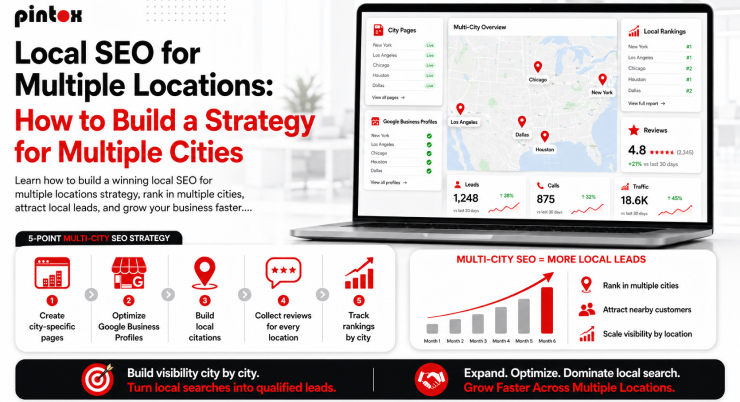
Customer reviews really boost trust, help with ranking, and increase the chances of people using a location’s services. To get a good local SEO for multiple locations strategy going, it’s not just about tossing city names around on your site. The real deal involves making distinct location pages, perfecting Google Business Profiles, keeping NAP info accurate, getting those customer reviews, snagging local backlinks, and putting out super useful location-specific content.
No matter if you’ve got two spots or twenty, the point is to make it easy for search engines to understand where you are and for folks to find your closest spot.
Pintox helps companies come up with local search plans that work, driving visibility, leads, and steady growth. If you’re looking to amp up your rankings, drive more local traffic, and start serving new areas, our Local SEO Services team can put together a plan that fits your business needs.