
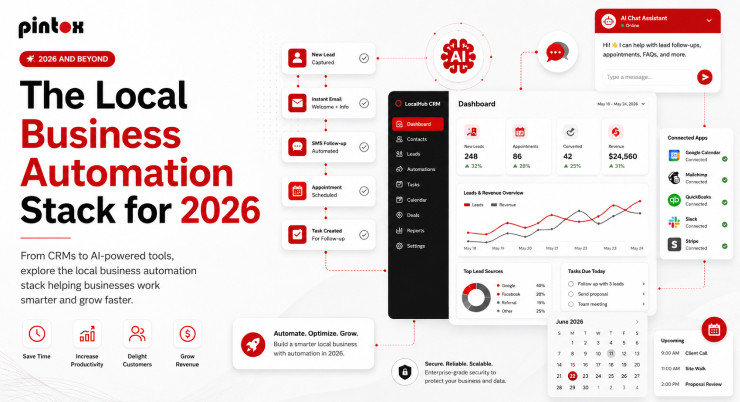
Small businesses today have to encounter numerous challenges while running their businesses. They are expected to respond promptly, maintain good communication, have easy scheduling and personalized services. However, at the same time, they have to worry about marketing, selling, staffing, etc.
That’s precisely why the local business automation stack has become one of the key considerations for growing businesses in 2026. As more companies look for ways to automate repetitive tasks and improve efficiency, our automation specialists at Pintox are helping local businesses build smarter systems that support growth without adding complexity.
In this article, we’ll talk about what a local business automation stack is, which features it has to include, and how technology can help your company grow and thrive.
What Is a Local Business Automation Stack?
The local business automation stack refers to an entire system of software applications that work together in helping businesses handle customer relationships and operations without too much involvement from humans.
It means that businesses are developing a system where they will automate their operations without needing separate tools to do so.
A local business automation stack usually consists of:
- Customer Relationship Management (CRM) software
- Marketing automation tools
- Appointment scheduling systems
- Communication platforms
- Sales automation software
- Reputation management solutions
- AI-powered customer support tools
- Reporting and analytics dashboards
The goal is to reduce manual work, improve customer communication, and create a smoother path from inquiry to customer retention.
Why Local Businesses Need Automation in 2026
Expectations of customers keep growing each year. People expect an instant response, quick booking, customized communication, and follow-ups.
Unluckily, most small local businesses depend on manual processes, which result in losing valuable time and opportunities.
Common challenges include:
- Missed calls during business hours
- Slow response times to inquiries
- Inconsistent follow-up
- Lost leads in spreadsheets
- Manual appointment booking
- Poor visibility into the sales pipeline
- Difficulty tracking marketing performance
Properly constructed automation stacks help overcome these challenges by setting up automated workflow procedures which will allow the business to operate effectively even without the employees around.
This will enable them to increase their ability to acquire customers, convert more leads, and ensure an excellent customer experience.
The Core Components of a Local Business Automation Stack
1. CRM Automation
Every local business software stack requires an advanced CRM system at its core.
CRM software captures customer data, manages contacts, creates an overview of opportunities, and helps organize sales processes.
Using the automation capabilities of modern CRMs allows for:
- Lead capture
- Lead distribution
- Customer engagement tracking
- Pipeline management
- Automation of reminders and notifications
- Monitoring of customer history
Without such CRM automation, companies tend to lose sight of their leads and face difficulties with growth management.
CRM systems in 2026 are becoming smarter and capable of making predictions and implementing automated actions for efficient team work.
2. Lead Management Automation
However, this is only the first step. The key is to make sure that all leads get the attention that they deserve in a timely fashion.
By automating local business lead management, you can ensure that leads generated by:
- Website forms
- Social media promotions
- Google Business Profile
- Landing pages
- Online advertising
- Referred leads
Get managed using an automatic lead capture process. Lead management automation ensures faster responses to leads generated by various sources.
In fact, businesses that generate local leads and employ lead management automation in their strategies have much better outcomes compared to others.
3. AI Receptionist and AI Voice Technology
One of the major developments in terms of technology being used by the local business community pertains to the use of AI-enabled customer communication.
AI receptionists are able to take care of customer calls, qualify leads, arrange appointments, give answers to frequent queries, and transfer the calls to the correct departments.
One of the main advantages of using such technologies relates to the solution of one of the most important problems for businesses providing services – missed calls.
Each missed call means loss of a potential customer. Modern AI solutions with the help of missed call management help in solving this problem with the help of instant responses and efficient communication.
AI voice assistants are becoming popular with businesses as a means of freeing employees for other tasks.
4. Customer Journey Automation
The contemporary buyer experiences various interactions with an organization prior to making a purchasing decision. This is why customer journey automation becomes an integral component of the contemporary business automation stack.
Customer journeys may be automated in such ways as:
- Greetings
- Appointment confirmation
- Reminders
- Follow-ups
- Reviews solicitation
- Re-engagement campaigns
In other words, the business can ensure a uniform experience for the customers by designing communication paths. But most importantly, customer journey automation helps not to lose any client.
5. Marketing Automation Tools
Marketing demands consistency, yet it is tough to achieve consistency when one’s team is dealing with several projects at once. That is why marketing automation tools are crucial. An advanced marketing automation solution for local business marketing can help automate the following activities:
- Email campaigns
- SMS campaigns
- Lead nurturing campaigns
- Promotions
- Segmentation
- Campaigns monitoring
One does not have to send emails personally; one can set up automatic email distribution in accordance with specific criteria. It results in higher engagement levels and lower workloads. Companies that apply marketing automation usually enjoy enhanced conversion optimization.
6. Appointment Scheduling Automation
The problem of making appointments continues to be an important operational issue for many small enterprises. The use of manual methods in scheduling often results in:
- Schedule clashes
- Administrative burdens
- No shows
- Delaying of responses
Appointments can be scheduled using software that will enable clients to schedule services available at any particular time. They also send out notifications such as:
- Confirmation of bookings
- Reminder messages
- Reschedule requests
- Additional information
Automation in appointment scheduling provides businesses offering services with a quick solution for increasing efficiency.
7. Customer Follow-Up Automation
Most companies end up losing their money not because of bad services, but simply because they do not keep up with follow-up procedures. Automated customer follow-up processes for local business make sure that all potential clients get the right kind of communication at the various stages of their interaction with the business.
The following are among the possible aspects of automated follow-up:
- Lead response sequence
- Proposal reminder
- Appointment reminder
- Post-service communication
- Review request
- Up-selling
Such a process is likely to foster better client relationship management. Follow-up automation also contributes largely to lead nurturing efforts.
8. Reputation Management Automation
Online reviews are now some of the biggest drivers of local purchase decisions. Reviews are regularly consulted before selecting the best-suited business.
Automated processes help automate reputation management through:
- Automatic sending of reviews
- Watching for online reviews
- Informing the team about reviews
- Prompting clients to write reviews
Through positive reviews, businesses gain more credibility and local visibility.
Building the Best Automation Stack for Local Businesses
There is no one-size-fits-all solution when creating the best automation stack for local businesses. However, most successful systems share several characteristics:
Centralized Data
- Customer data must flow effortlessly between tools.
- Inefficient systems lead to inefficiency and higher chances of mistakes.
- Automated Communication
- Companies must automate customer communication without making the process impersonal.
Examples include e-mail marketing, SMS marketing, appointment reminders, and follow-ups.
2. Integrated Workflows
Every component of the local business automation stack should work together.
For example:
- New leads enter the CRM automatically.
- Follow-up sequences begin instantly.
- Appointment scheduling occurs without manual intervention.
- Review requests are triggered after service completion.
- Actionable Analytics
Business owners need clear visibility into performance metrics. Reporting dashboards should provide insights into:
- Lead generation
- Sales pipeline performance
- Conversion rates
- Marketing campaign results
- Customer retention trends
How to Automate a Local Business Successfully
Entrepreneurs always wonder about how to automate their business locally without complicating things. The solution here is to begin with areas that require more attention.
Consider automating the following:
- Lead capture
- Client communications
- Appointment scheduling
- Follow-ups
- Testimonial gathering
- Sales process
With these processes up and running successfully, you can consider adding further work-flow automations one at a time. It’s not about doing all your automation at once but rather about automating the tasks that take the most amount of your time and bring business value.
Business Automation Trends 2026
Several key business automation trends 2026 are shaping the future of local businesses.
Communication Based on Artificial Intelligence
The capabilities of AI-based technologies are becoming more and more advanced and allow for improved accuracy and conversation.
Unified Business Tools
Instead of scattered tools, businesses are turning towards unified business platforms that cover CRM automation, marketing automation, communication, and reporting.
Proactive Customer Engagement Based on Predictions
Data is being used for predictions and automation of customer engagement in the automation platforms.
Sales Automation
Modern sales automation software allows businesses to focus on opportunities and convert prospects quicker than ever before.
Hyper-Personalization
Increasingly advanced automation technology helps businesses create hyper-personalized content for customers.
Frequently Asked Questions
What is a local business automation stack?
An automation stack consists of all the tools used to automate the processes of marketing, managing leads, customer communication, scheduling appointments, and follow-ups for local businesses.
Why should local businesses automate?
Automation is beneficial for local businesses to save time, lessen manual tasks, enhance their customer experience, and even earn more leads without having to hire more personnel.
Which tools should be part of a local business automation stack?
A typical automation stack should consist of CRM, marketing automation tools, artificial intelligence voice agent, review management tools, appointment scheduler, and dashboard.
What would help local businesses to earn more leads through automation?
The leads are automatically captured, contacted immediately, and nurtured throughout the sales process.
Are automated systems expensive for small businesses?
No. There are many affordable options available in today’s market that can be used instead of using individual tools.
How does automation help customer retention?
Automation allows consistent communication, follow-ups, appointment reminders, reviews, and customer interaction.
What is the best CRM for automating a local business?
There is no one-size-fits-all answer to this question, but CRMs that incorporate automation and marketing can be quite beneficial.
Final Thoughts
It won’t necessarily be the biggest businesses that succeed in the coming years. Businesses that perform well will be those that run efficiently and provide an outstanding customer experience.
The right automation stack in your local business provides companies with the ability to simplify business processes, build solid relationships with their clients, and scale without becoming overly complicated.
With everything from CRM automation, customer communication automation, intelligent support through AI, appointment booking and scheduling, and workflow automation, there are endless possibilities for growth offered by today’s technology.
As local business automation solutions in 2026 continue to develop, companies who use automation in their processes will gain the upper hand in generating more leads and increasing customer satisfaction.
For local businesses in 2026, the future of AI automation doesn’t mean taking over from humans. It means equipping them with the right system to do their job better.