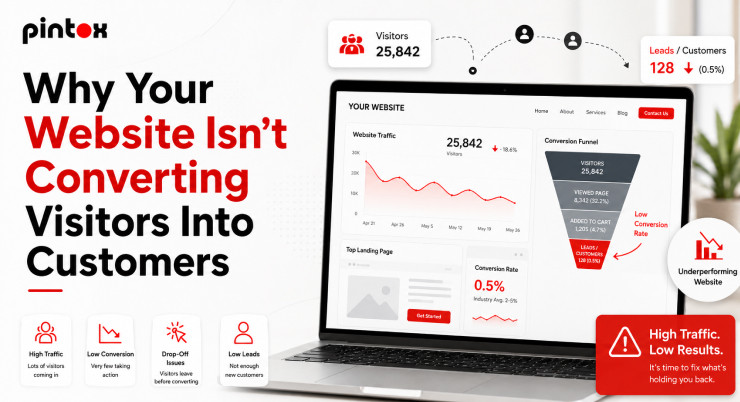
The process of attracting people to your website doesn’t stop there. Things get much harder when they finally come to visit your website. Having a lot of visitors on your website and not getting any enquiries or bookings from them is quite a common problem among business owners. One of the most widespread problems of many business owners is why their websites do not convert traffic into leads, enquiries, bookings, and sales despite efforts made in terms of digital marketing.
Most of the businesses think that more traffic equals more money, but in actuality, there’s little use in traffic without conversions. An effective website is supposed to provide visitors with a clear customer journey, motivate them to take action, and contribute to reaching your goals. Regardless of whether you aim to get more leads or sell something, your website is supposed to serve as the best salesman.
A low website conversion rate can be caused by multiple little things rather than one big thing. Lack of proper messages, slow loading speed, confusing design and navigation, weak call-to-action and lack of trust are just a few things that prevent potential customers from making actions and turning into your clients. The good news is that these problems are usually fixable with the right strategy and ongoing website conversion optimization.
If you have been wondering about why your website gets traffic but not sales, or if you’ve been trying to figure out why your website receives visitors but not leads, then you’re asking the right questions. It may not necessarily be about getting more visitors, but rather about utilizing your existing visitors.
In this guide, we’ll be taking a closer look at some of the most frequent causes of why websites fail to convert, as well as some useful website conversion tips that may help you improve your website conversions and generate more leads from your website.
Why Your Website Gets Traffic But No Customers
A constant flow of visitors to your website might look like an excellent thing, but it cannot be guaranteed to bring you any success. Many websites have lots of visitors thanks to SEO optimization, but still do not manage to turn them into clients. And this is when most companies start to question why marketing strategies do not work for them.
The point is that it is not enough just to attract visitors; you need to make sure they are relevant and interested in the products/services you are selling. Even if it is so, there are some things you need to pay attention to on your website.
Imagine it as your storefront – people come to it and leave not buying anything. It means that somewhere in the process of visiting your website, they lose motivation to make the final step.
Another essential aspect is knowing what your visitors want. Everyone comes for a reason. Some come looking for information, whereas others have already made up their mind to take action. Should your web page content fail to meet their expectations, you will end up losing them almost immediately, with the bounce rate becoming even higher.
That is why companies that manage to succeed keep analyzing their website statistics and Google Analytics data to see how their visitors behave and how they can make it possible for them to interact more with the company. In most cases, decisions made based on facts yield much better results than those taken based on assumptions.
In conclusion, improving the conversion rate of your website is not about convincing everyone who visits it to make purchases.
Your Website Doesn’t Match Search Intent
Another reason for your website failing to convert visitors into clients is due to mismatched content. If the person is searching for something like “affordable commercial roofing services” but ends up on a site that is mostly dedicated to telling them the history of the company, then they would simply move on to another website.
The content may provide useful information, but it certainly does not solve their problem and does not cater to their needs. It is very important that each of your pages has a definite purpose behind it. Your title, copy, images and offers must come together to assure visitors that they are at the right spot.
This is when conversion-oriented website design comes into play. The effective website design goes beyond the visual – this way, users can easily navigate your site, learn about your services, and proceed through the sales funnel smoothly.
Navigation is also very important for that. Proper website navigation means that users can easily get the information that they need without any difficulty—the menus must be clear, pages with services must be easy to reach, and any crucial information cannot be hidden by unnecessary clicks.
Your website that meets the user’s expectations will attract more customers.
Weak Headlines Fail to Grab Attention
The headline will be the first thing that a visitor sees, and depending on it, they may either stay or leave your page. Being vague or centered on your business needs instead of customer needs can cost you many leads.
A good headline should explain what you offer, to whom, and why readers should pay attention. Headings throughout the page should also be scanable for higher usability and better engagement.
It is also important to maintain consistency: the headline of your page should not contradict the message in your advertising campaigns and in search results. Good headlines should go hand in hand with good CTAs, and with a powerful website call to action that will motivate users to make an appointment or contact your company for a quote.
Small changes in headlines and their testing using the A/B testing technique can lead to high website conversion optimization.
Website Speed Too Slow? People Will Leave Your Site Right Away
If your website is too slow, it may repel people from it right away. In today’s time, when everybody expects their pages to load in an instant, even the smallest delay may have a bad effect on your website conversion rate.
Fast loading time of pages will ensure better user experience of the website, as well as help rank better due to Core Web Vitals. That is why website conversion optimization is critical both for SEO and conversions.
Over-sized images, outdated plugins, and inefficient hosting are some of the common reasons behind the slow website. Website maintenance will help your website stay fast and functioning, especially if you own a local business, since there the users expect everything to be easily accessible.
With the investment in website speed and UX, you will gain more enquiries.
Your Call-to-Action Isn’t Clear
One of the major reasons your website is not generating conversions for you is the poor call-to-action on your website. Visitors will definitely leave your website if there are no actions that they need to take on your website.
Each and every webpage needs to have one clear objective, whether it is to request a quote, schedule a consultation, or contact you. Make your CTA buttons easy to find, action-oriented, and place them throughout the page to support a smoother conversion funnel and better website conversion optimization.
The purpose of an effective call-to-action is to make your visitors your customers.
Poor Mobile Experience Hurts Conversions
A mobile-friendly website is important because most people will visit the website using their mobile devices, such as smartphones and tablets. In case the website cannot be used easily on a small screen, then the visitor will leave the website.
A responsive mobile website, good loading time, and proper navigation make the website‘s user experience good, which makes the website rank high during search. Adopting proper website navigation and landing pages optimize the process of converting.
A website that works well on all devices will enhance smoothness in its functioning and conversion of visitors.
Your Contact Form Creates Friction
It is important to note that a difficult contact form may keep people from contacting you. As such, there is a possibility of losing some leads.
Make sure that your lead capture process remains simple and that the required details remain minimal. This will increase usability and conversions.
Always make sure that you use heat maps and conduct A/B testing for improvements and also have a confirmation message after the submission process.
You’re Attracting the Wrong Audience
Not all visitors can become clients. You will attract visitors to your site but fail to convert them into website leads if you market using irrelevant keywords or target the wrong demographic.
In order to attract website leads, you should first know your ideal customer and create content that caters to their needs. This way, you will be able to generate traffic that is more valuable for you, optimize your website conversion rate, and also help you optimize your sales funnel.
Website analytics will allow you to see which marketing campaigns work better and which do not.
No Follow-Up After Someone Converts
Creating a lead enquiry is just the first step. Leads might not convert into customers without follow-up in time.
Marketing automation to help create immediate email follow-ups, along with the use of AI follow-up, would be useful to keep the leads engaged and make sure that no enquiries are overlooked. Integration of your website via CRM would help manage the leads better during their nurturing.
Remember, the conversion does not happen after the lead submits their form, but when they converts into a customer.
How to Turn More Website Visitors Into Customers
Have you ever wondered how to turn your site visitors into your clients? Well, in most cases, it does not require you to redesign the whole website. All you need is to make some changes and eliminate the barriers for your visitors.
First, check out your website through the eyes of your potential client. Is it clear to them what you are offering? Is it possible to get all the necessary information about your business quickly? Are your pages well-structured and fast enough?
Think about creating optimized landing pages that will be focused on particular customer needs instead of being universal. Every landing page should have its goal and main action for a visitor to take.
Keep analyzing your performance in Google Analytics and other similar services. Watch your conversion rate, find out which pages have a high exit rate, and look for ways to improve them.
Conversion rate optimization will require continued effort throughout the process rather than a one-time effort. Frequent testing, updating of content, improving navigation and messaging will all add to better results. Companies that keep checking and improving their sites stand to make improvements in their website conversion optimization much easier.
Above all, it is important to note that the website will have to act as a dynamic tool for selling and marketing rather than a simple brochure.
Frequently Asked Questions
Why am I getting traffic but not any sales from my website?
It is because there is an absence of proper coordination between your website and the needs of the visitors. The reasons could be that you have bad messaging, user experience, load times, calls-to-action, or wrong visitors coming to your website.
What should be a good conversion rate for a website?
It depends on what type of business you are dealing in. But on average, a lot of businesses set their goals somewhere in the range of 2% to 5%.
Does website speed have an impact on conversions?
Yes, since the slow websites are known to have high bounce rates and poor customer satisfaction levels. Fast websites deliver a better experience and result in higher conversions.
Why are trust signals necessary for your website?
These can range from things like customer testimonials, ratings, accreditation, secure payment symbols, and other business details to assure the visitor that your business is worth their time. Trust signals lessen the uncertainty, and the possibility of inquiries or purchases increases.
What is the frequency for optimization of the website?
Web optimization should always continue. There is no specific date when you should start the process of optimizing your website.
Conclusion
Professional web design by itself will not result in steady business generation. When your web design is bringing in visitors but failing to make any inquiries or sales, there are a number of reasons for this.
User intent and website speed optimization are just some of the areas that must be addressed, along with increasing website trust signals, reducing the complexity of contact forms, and enhancing your call-to-action on your website.
The important point to understand here is that you do not necessarily have to increase traffic to increase your business. Website conversion optimization can help you maximize existing traffic.
In the end, what makes the successful businesses on the Internet is that they continuously analyze their website, listen to their users’ behavior, and adjust to the new requirements of their customers. Your website is a valuable asset if you build it with the interests of your target audience in mind, since it will generate leads and relationships to ensure your company’s development.
Are you willing to enhance the performance of your website, but don’t know how to start? Our professional team from Pintox can assist you with that. We offer various services, including strategy development, web design for conversions, and many others.