Business owners focus on marketing and advertising and put significant effort into acquiring customers. They dedicate their time to developing products, improving the process of selling and increasing their brand awareness. Nevertheless, there is an important aspect which is related to all mentioned above: it is website speed optimization.
A website may look very professional and contain relevant information; however, due to poor loading time, visitors may leave before they even see what the business has to offer. We at Pintox understand that at present, speed becomes not only a technical question; it also becomes a business that is associated with money, satisfaction of customers and growth.
It turns out that many organizations do not pay enough attention to the connection between website performance and revenues. However, scientific studies prove that even a few seconds of delay in loading time can negatively influence the results of conversion and affect customer experience negatively.
Why Website Speed Matters More Than Ever
The customers require prompt access to information. While searching online and choosing products, they expect quick response times from websites.
When there is no immediate response, frustration sets in. A slow website does not make a good impression on people, leading them to search other websites.
This is where website speed optimization comes into play. Fast-loading websites provide a smooth user experience, improve engagement, and increase visitor dwell time. What is more, fast sites increase the chances of completing required actions, like making purchases, asking for quotes, making appointments, and filling in contact forms.
Each second counts because customers do not waste their time on slow pages.
The Hidden Cost of Slow Loading Websites
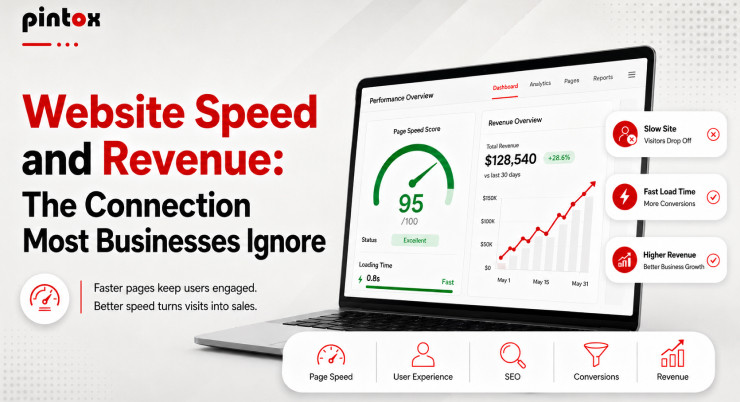
However, many organizations pay much attention to visible expenditures like marketing budgets and staff costs but neglect losses due to poor website performance in terms of revenue. The slow website impact on sales may be significant. Losses for a business come when potential clients leave the site before looking at the company’s products/services.
Typically, a slow website may cause:
- Increased abandonment
- Reduced client trust
- Poor lead generation
- Less number of purchases
- Poor customer satisfaction
- Less number of return visits
All of these have a direct effect on the revenue generation. Even though an organization keeps spending on drawing people to their websites, slow pages do not allow visitors to become clients.
An improvement in website loading speed is often one of the cheapest methods of generating additional revenue.
Website Speed and Conversions: A Direct Relationship
Website speed optimization is one of the reasons why the process should be used on a company’s website.
The relation between speed of the website and conversion is very clear because when a website is faster, all the steps within the customer journey become easier. Users will not face any issues while surfing the website and finding needed information. The user experience becomes better and more engaging.
Companies that pay attention to optimization of the conversion rate of the website understand how fast the website should be.
Faster websites make the customer journey smooth and help users to stay engaged until the end of the process.
How Website Speed Influences User Experience
Expectations of customers have evolved considerably during the last ten years. Website visitors demand instantaneous response from their website. Good website user experience relies greatly upon speed. Website visitors expect websites to be fast in loading their pages, opening up menus, displaying contents etc.
Website speed determines:
- Navigation
- Accessibility of information
- Satisfaction of users
- Credibility of business
- Engagement in general
Fast websites are an important factor for good website usability, since it allows users to perform tasks effortlessly. Slow websites make things difficult for users. Firms that focus on speed optimization of their websites usually achieve better results regarding user engagement and customer loyalty.
The Mobile Speed Challenge
The proportion of internet traffic coming from mobiles has significantly risen across the globe. Thus, the mobile website speed has become one of the key elements that affect the performance of any business online. Mobile users are accessing websites via different types of networks. If the web pages are not optimized, it will take much longer for them to load.
A bad experience from visiting a website via mobile will lead to:
- Higher mobile website bounce rate
- Lower conversions
- Lower engagement
- Sales losses
Mobile-first indexing by Google shows how relevant mobile speed is today. The sites that provide a good experience from their mobile version will have a better chance to stand out in search engines and win customers. Optimization of the site speed for mobiles is a must today.
Website Speed and SEO Performance
Many companies tend to see search engine optimization and web performance as independent operations. In actuality, however, there is an intrinsic connection between them. Website speed for SEO purposes have been growing in importance due to the rising role of user experience at search engines.
Google measures page load times via a number of parameters, such as:
- Core Web Vitals
- Largest Contentful Paint (LCP)
- First Input Delay (FID)
- Interaction to Next Paint (INP)
They show how fast content is loaded by users and how responsive a website is to them. High speeds allow generating more page experience signals that may favorably affect SEO rankings.
Furthermore, faster sites allow for more efficient crawling by search engines. When combined with quality content and strong SEO practices, website speed optimization can contribute to better search visibility and increased traffic.
What are Core Website Performance Metrics
Enhancing the speed of a website involves measuring the appropriate parameters. Companies must keep track of important website performance metrics in order to improve their web pages.
The most important metrics are:
Largest Contentful Paint (LCP)
The metric is used to measure the duration of loading the main content of the web page.
First Input Delay (FID)
The metric reflects the website’s performance on the first interaction with the user.
Interaction to Next Paint (INP)
The metric evaluates the responsiveness of the website and helps measure users’ interactions with the website.
Website Bounce Rate
High bounce rate of the website may be an indicator of poor performance.
Website Conversion Rate
Monitoring the link between the conversion and speed helps companies to understand how much they lose on the speed of the website.
Monitoring these metrics with the help of website analytics will help businesses enhance their performance.
Why Slow Websites Hurt the Conversion Funnel
Each company has some kind of funnel that helps achieve certain objectives, whether it’s about lead generation, consulting, or selling items online. The slow loading time causes trouble at all stages of this funnel:
- Potential clients might abandon the website before reading information about the services offered,
- before checking the products,
- before finding prices,
- before filling out forms, and
- even before making purchases.
Poor site performance can be the reason for checkout abandonment which is especially costly for e-commerce companies. Even a little increase in page load speed will do good.
Common Causes of Poor Website Performance
There are many performance problems that are avoidable. Technical problems that arise with websites include the following:
- Large image file sizes
- Many plugins
- Ineffective code
- Insufficient hosting setup
- Too many third party scripts
- Caching is not implemented
- Outdated website architecture
All of these things may contribute to poor page performance and decrease customer satisfaction. A site performance audit will help uncover any potential problems.
Building an Effective Website Optimization Strategy
Many companies view website speed optimization as a one-time thing where some changes are made and forgotten. However, it is necessary for the site to be maintained continuously, since with technological development and adding new components the site becomes slower. The key idea of a good strategy of website optimization is not to think of it as a process of quick fixes, but as the constant process of improvement. Website optimization involves such techniques as image compression, reduction in server response time, elimination of unused scripts, optimization for mobile devices, browser caching, and regular check of the performance statistics.
The Impact on Lead Generation and Customer Acquisition
In the case of services firms, speed of the website impacts the process of generating leads. Slow website speeds may result in fewer inquiries, appointment setups, and completed forms. A fast lead generation website is an assurance and motivates visitors to act.
The benefits of speed enhancement include:
- More lead generation from websites
- Customer engagement
- Higher form completions
- Sales opportunities
- Website traffic conversion
Because of the costly nature of obtaining traffic, making the best out of available traffic is important for all companies.
Speed Supports Operational Efficiency
The performance of a website has an impact that extends beyond customer experience alone. Faster websites help improve operational efficiency through fewer support calls, reduced frustration of customers, and better digital processes.
When customers can easily find the information they need, make transactions, and access resources without assistance, companies save time on solving preventable problems.
The Long-Term Revenue Benefits of Website Speed Optimization
There are many instances where companies concentrate on the immediate marketing returns without considering the long-term improvements in performance. The fact remains that website speed optimization offers benefits which keep on creating value in the long term.
Some of the advantages are:
- High conversion rates
- Good customer retention
- Increased searchability
- Increased trustworthiness and credibility
- Enhanced customer experience
- Revenue generation potential
This creates an edge for faster websites and ensures growth in various areas within the business. As customer expectations keep increasing, companies focusing on speed will have an edge over their competitors.
Frequently Asked Questions
Is there any effect on income by having a slow website?
Yes. A faster website will have less bounce rate and better user experience and hence more chances of making sales.
What is the effect of a slow website on conversions?
A few additional seconds will result in less conversion rate, higher abandonment rate and loss of income potential.
Is there any SEO ranking effect by having a slow website?
Yes. The search engines look at the page experience and Core Web Vitals of websites while assessing them.
What is a good load time for a website?
It is suggested by most professionals that websites should load between 2-3 seconds, especially in mobile devices.
How do I determine my website speed?
Tools like Google PageSpeed Insights, Lighthouse, and GTmetrix can help you find out about any problems with the speed of your site.
Why does website speed matter for mobiles?
Users mainly use their smartphones to navigate the web. The slower it loads, the faster people leave the page and don’t convert.
Will increasing website speed get me more leads?
It will help. Fast websites provide an excellent user experience and encourage customers to contact your company.