
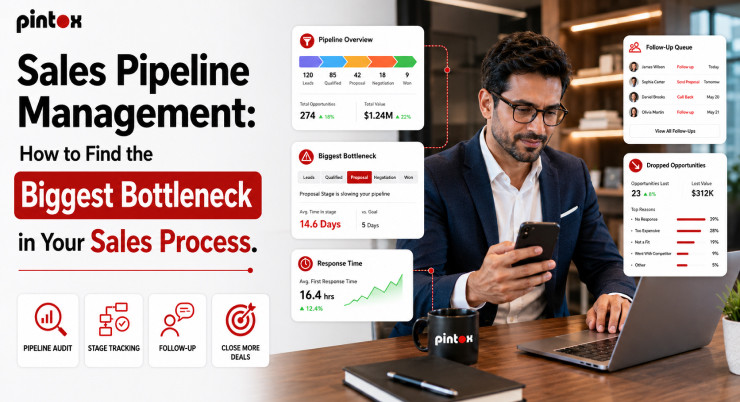
Most businesses do not have a problem with the number of leads.
They have a process problem.
New leads pour in daily. Sales calls start. Opportunities arise. Proposals are made.
But for some reason, the revenue does not increase accordingly.
Business owners often tend to believe that they require more leads when what they actually need is a solution to their internal sales process problem. Leads flow into their sales pipeline; yet they fail to manage them efficiently.
Herein lies the significance of Sales Pipeline Management as one of the crucial growth strategies for companies today.
An effective sales pipeline makes it possible for businesses to spot bottlenecks where deals are progressing, stagnating, or slipping away. The problem lies in the fact that there may be hidden obstacles in a company’s sales pipeline.
Any slight delay in follow-ups, a poorly managed qualification process, or irregular sales activities pose serious problems within the sales pipeline.
This blog will guide you through ways in which sales pipeline management can help your business uncover these bottlenecks and drive sales success.
What Is Sales Pipeline Management?
Before identifying bottlenecks, it’s important to understand the definition of pipeline management.
Pipeline management is basically defined as the systematic management of each and every opportunity as they progress through their sales cycles. As prospects move from being just inquiries to finally becoming customers, they will be passing through a number of pipeline stages such as:
- New Lead
- Contact Made
- Opportunity Qualified
- Discovery Call
- Proposed
- Negotiated
- Won
- Lost
By effectively managing a sales pipeline, businesses will know where all opportunities are and what their status is. Without having a well-managed pipeline, businesses won’t have any idea of how deals are progressing and hence will be unable to predict future earnings.
Why Bottlenecks Are Costing You More Than You Think
It’s best to think of your sales pipeline as a funnel where you constantly pump in new leads at the top, yet the presence of some kind of obstruction in the middle will limit the number of clients passing all the way through.
This pretty much describes any typical sales process out there. Even if you are acquiring lots of leads, an inadequate stage in the process will hold up your sales cycle and result in lost revenue, delays in closing deals, going cold on prospects, lack of follow-up, and erroneous sales forecasting.
Such problems may eventually impact the productivity of the sales team negatively, making your growth goals seem impossible to achieve. This is why sales pipeline management is not limited only to deal tracking in a CRM system.
Its real purpose is to identify where opportunities are getting stuck, understand why they’re not progressing, and remove the obstacles that are preventing prospects from moving toward a buying decision.
The Hidden Cost of Pipeline Blind Spots
Many companies only focus on closed deals. They rarely examine what happens between lead generation and contract signing. As a result, pipeline gaps remain unnoticed.
For example: An organization is able to bring in 100 leads every month, out of which twenty make appointments, ten get offers from them, and only three buy their products.
However, very few organizations recognize the significance of focusing on the other ninety-seven leads rather than just the three successes.
This is why pipeline visibility plays such an important role.
The First Step: Conduct a Sales Pipeline Review
The quickest way to identify any bottleneck is through a comprehensive sales pipeline audit. Rather than concentrating exclusively on the numbers, determine the way deals flow from one stage to another.
Some critical questions to ask include:
- At which stage do you have the most loss of business?
- At which stage do you lose business the slowest?
- At which stage do you create the most delay?
- Which reps close their deals the fastest?
- Where do deals stall out?
Performing an effective sales pipeline audit can highlight issues that might be hard to identify during the regular course of business activities. Companies have discovered that their greatest challenge is not lead generation but sales pipeline management.
Common Bottlenecks That Slow Down Sales Growth
Every business is different, but certain bottlenecks appear repeatedly across industries.
- Slow Lead Response Times
One of the biggest sales killers is poor lead response time.
- A prospect submits a form.
- Hours pass.
- Sometimes days.
By the time a salesperson responds, the prospect has already contacted competitors. Research consistently shows that faster responses significantly improve conversion rates. Businesses focused on Sales Pipeline Management prioritize speed because momentum matters. The faster the response, the greater the opportunity.
2. Poor Qualification Processes
Not every lead belongs in your pipeline. When unqualified leads enter the system, they consume time and resources. This creates:
- Stalled deals
- Pipeline risks
- Lower sales effectiveness
- Reduced sales team performance
Strong qualification frameworks help sales teams focus on opportunities with genuine potential.
3. Inconsistent Follow-Up
Many deals are not lost because prospects say no. They are lost because nobody follows up. Without automation and accountability, opportunities quietly disappear.
This often results in CRM lead leakage, where potential customers fall through the cracks despite showing interest.
How Pipeline Stages Reveal Bottlenecks
One of the most effective sales pipeline management tips is measuring conversion rates between stages.
Consider this example:
- 100 Leads
- 70 Contacted
- 40 Qualified
- 25 Discovery Calls
- 20 Proposals
- 5 Closed Deals
The biggest drop occurs between proposals and closed deals. That immediately tells you where to investigate.
- Perhaps pricing is unclear.
- Maybe proposals lack urgency.
- Possibly competitors are winning late-stage conversations.
Understanding sales pipeline stages best practices helps uncover exactly where intervention is needed.
Signs Your Sales Pipeline Is Unhealthy
Watch for These Warning Signals. A healthy pipeline demonstrates consistent movement. An unhealthy pipeline often shows:
- Large numbers of inactive deals
- Opportunities remaining unchanged for weeks
- Declining pipeline value
- Frequent deal slippage
- Low pipeline coverage ratio
- Poor forecast confidence
- Excessive deal volume without conversions
These indicators often point to larger process bottlenecks. Regular pipeline reviews prevent these issues from becoming long-term problems.
The Role of Technology in Sales Pipeline Management
Today’s modern CRM tools have made pipeline management quite easy for organizations. Having the appropriate tool ensures that you will get real-time visibility of your pipeline, making it easier to identify potential issues in processes before they start impacting your sales goals.
Pipelines in GoHighLevel offer several benefits such as centralized tracking, automation, reports, and follow-ups. You do not need to use spreadsheets anymore when dealing with your pipeline as you have everything from one dashboard.
Why a Good CRM Workflow Matters
Technology alone doesn’t solve pipeline problems. The process behind the technology matters just as much. A good CRM workflow ensures every opportunity follows a consistent path through the sales funnel.
Without structure, even the best CRM becomes little more than a contact database. An effective workflow should include:
- Automated lead assignment
- Immediate follow-up sequences
- Task reminders
- Stage progression rules
- Activity tracking
- Reporting dashboards
When workflows are properly designed, pipeline health improves naturally. At Pintox, we’ve worked with businesses that believed they needed more leads. After reviewing their pipeline, the real issue became obvious.
Leads were entering the system successfully, but follow-up delays, inconsistent stage tracking, and outdated processes were causing opportunities to disappear.
By improving Sales Pipeline Management, automating follow-up processes, and creating stronger CRM workflows, businesses often recovered revenue that was already sitting inside their existing pipeline.
In many cases, fixing bottlenecks delivered faster results than increasing advertising spend. This approach has helped Pintox clients improve sales productivity while creating more predictable revenue streams.
The Connection Between Pipeline Management and Revenue Forecasting
Accurate forecasting depends on reliable pipeline data. When businesses fail at managing sales pipeline processes, forecasts become unreliable. Businesses looking to improve efficient lead pipeline management strategies should focus on the predicted struggles:
- Future revenue
- Staffing needs
- Marketing budgets
- Growth opportunities
Strong deal pipeline management creates visibility into pipeline performance while increasing confidence in sales forecasts. The more accurate your pipeline data, the easier it becomes to plan for growth.
Why Regular Pipeline Reviews Should Never Be Optional
One of the most effective yet often overlooked sales pipeline best practices is conducting regular pipeline reviews. The weekly review helps salespeople get an overview of their activities rather than getting stuck on everyday actions.
In addition, reviews will reveal any problems that you might have in your pipeline, including lack of coverage in the pipeline, stalled deals, and inefficient processes that slow down the progress of other tasks.
Moreover, they allow finding potential threats to your revenues that may not be obvious in everyday work. By neglecting regular reviews, small issues may turn into big ones before you even notice them.
Companies that proactively manage your sales pipeline are usually able to act quicker than others who assess their activities at the end of the month.
How GHL Services Can Improve Pipeline Efficiency
Many growing businesses struggle to build effective sales systems internally. This is where professional GHL services can provide significant value.
A properly configured CRM platform helps businesses:
- Automate follow-up
- Improve pipeline visibility
- Reduce lead leakage
- Track deal progression
- Increase sales productivity
- Strengthen forecast accuracy
When paired with strong strategy and execution, CRM automation becomes a powerful growth tool.
Frequently Asked Questions
What is Sales Pipeline Management?
Sales Pipeline Management refers to the systematic tracking and managing of various stages within the sales process from the beginning until completion.
How do you determine the bottleneck in a sales process?
Conversion rates analysis, deal stalling point identification, and conducting periodic sales pipeline analysis help determine bottlenecks in the process.
What are the common bottlenecks in a sales pipeline?
Bottlenecks that arise in a sales pipeline include late responding leads, bad qualification of leads, lack of follow-up, inactive deals, and ineffective proposal process.
Metrics that you should track in a sales pipeline?
The most important metrics include pipeline value, conversion rate, sales cycle duration, forecast accuracy, pipeline coverage ratio, and revenue forecasting accuracy.
Why are deals stuck in the sales pipeline?
The reasons why transactions become stalled are that the sales cycle may have been overlooked, no clear actions are known, there is budget constraint, lack of urgency, or miscommunication in the entire purchasing process.
How does a CRM help manage the sales pipeline?
A CRM improves pipeline visibility, automates follow-up tasks, tracks deal progression, reduces lead leakage, and provides reporting for better decision-making.
How frequently should the sales pipeline be reviewed by an organization?
An ideal period is once a week, but a quarterly review of the sales pipeline could give bigger trends.
Conclusion
But maybe that’s not what it takes for you to make your next big breakthrough. Maybe what you need is simply to clear up the existing bottleneck and turn all of those current opportunities into real customers!
Proper sales pipeline management enables companies to gain insight into their business and boost their performance and generate steady income.
At Pintox, we assist our clients to detect pipeline problems, streamline processes, automate operations, and grow their businesses. Be it challenges related to closing deals, lead nurturing, and/or revenue forecasting, the use of an intelligent sales pipeline management system can make all the difference in your business.
Are you interested in improving your sales pipeline management process? Feel free to get in touch with us and witness the benefits of good pipeline management first hand!