“This lead hadn’t replied in 3 weeks. GHL flagged them as hot. They closed 2 days later.”
Not luck. The AI caught something before anyone else did.
And if you’re still deciding who to follow up with based on gut feel or a sticky note on your desk, this is going to change how you think about lead nurturing for good.
Most Sales Teams Are Chasing the Wrong People
Here’s what actually happens in most businesses:
You’re spending time chasing leads who said “maybe” two months ago. Meanwhile, someone else has been quietly opening every email you sent, visiting your pricing page three times this week, and comparing you to a competitor. They haven’t said a word. So you haven’t done anything.
Then they sign with someone else. And nobody knows what went wrong.
The problem isn’t effort. It’s that you’re making decisions based on who talked the loudest, not who’s actually ready to buy.
That’s the problem that AI lead nurturing is built to fix. GoHighLevel watches what leads actually do, scores their behavior automatically, and tells you who’s about to make a move before they pick up the phone. That’s what a smart lead nurturing strategy looks like in 2025.
What Predictive Lead Nurturing Actually Means
Most people think lead nurturing just means sending a few emails after someone opts in. Schedule them out over a couple of weeks, add some value, and hope someone bites. That’s not really nurturing; that’s just emailing.
Predictive lead nurturing is different. Instead of going off a calendar, it goes off behavior. What did this person click? What page did they visit? How fast are they replying? Are they coming back to your site on their own?
When you build your lead nurturing strategy around signals like that instead of assumptions, everything changes. You stop sending the same sequence to everyone and start responding to what each person is actually doing.
The leads who are ready to buy get a fast-track sequence. The ones who need more time get more education. And the ones who’ve gone cold get a re-engagement campaign before they disappear for good.
That’s what separates a basic lead nurturing process from one that actually moves deals forward.
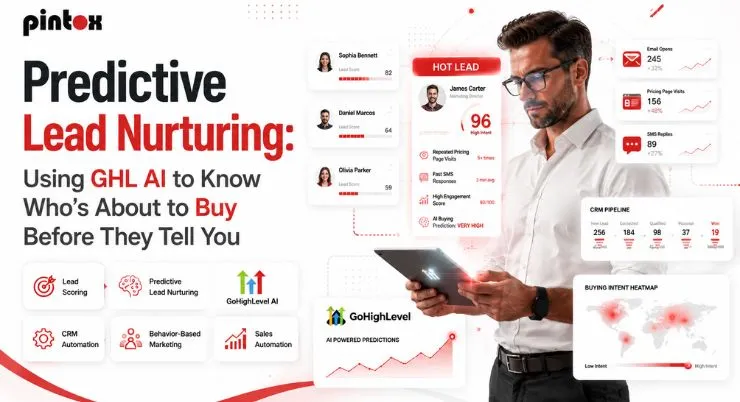
What GHL’s AI Is Actually Watching
Before you can set any of this up, you need to know what signals GHL is paying attention to. This is the foundation of the whole AI-led nurture system.
GHL tracks things like:
How fast someone opens your emails and what they click on. Whether they’re coming back to your website on their own, especially pages like pricing or FAQs. How quickly they reply to your messages. Whether their reply sounds like someone who’s just being polite or someone who’s actually ready to move. How long have they been sitting in the same stage of your pipeline without anything happening?
None of these signals means much on their own. But when you stack them together, they paint a pretty clear picture of where someone’s head is at. Even if they haven’t said a single word to you.
This is what makes AI in lead nurturing worth paying attention to. You’re not guessing anymore. The system is reading the room for you.
And the good news is that GHL does this for businesses of any size. You don’t need an enterprise budget to run lead nurturing strategies that used to be reserved for big sales teams with expensive tools.
How Lead Scoring Works Inside GHL
Lead scoring is the engine underneath all of this. The idea is simple. You give point values to actions, and when a lead hits a certain score, something happens automatically.
Here’s a basic example of how you’d set it up:
Someone opens an email; that’s worth 5 points. They click a link in that email and add 10 points. They visit your pricing page on their own; add 20 points. They reply to an SMS and add 15 points. They’ve had zero activity for 7 days; subtract 10 points.
When a lead hits 75 points, your workflow fires. Maybe that’s a text message with a booking link. Maybe it’s a notification to your sales rep. Maybe it’s a short personal email that feels like it was written just for them.
This is CRM lead nurturing working the way it’s supposed to. No manual reviews. No spreadsheets. The system does the heavy lifting and tells you who to focus on.
One of the most useful lead nurturing tips I can give you: weight your scoring toward actions that actually mean someone’s about to buy. A pricing page visit is a much stronger signal than someone reading a blog post. Make sure your scoring reflects that difference.
If you want to see how to build this out technically, some solid GHL automation tips for faster lead follow-up cover the structural logic you need before you start building your scoring rules.
Reading What Leads Actually Mean (Not Just What They Do)
Here’s something most people skip entirely: sentiment analysis.
When someone replies to your SMS or email, GHL’s AI can read what they actually wrote and figure out what it means. Not just “they replied” but “what kind of reply was this?”
Take these two responses. Person A says, “Not really sure this is for me right now.” Person B says, “Can you send me more details on the $997 plan?”
Both of them replied. But they’re in completely different places.
Without this kind of AI in lead nurturing, your system treats both replies the same way. With it, GHL routes Person A into a softer nurture sequence and moves Person B into a fast-track close flow automatically.
This is what takes your lead nurturing process from “we send follow-ups” to “we actually know what each person needs next.” You’re not just tracking what people do. You’re understanding what they mean.
Building the Whole Thing in GHL: Step by Step
Okay, let’s get into how this actually works. Here’s how you build a predictive lead nurturing workflow inside GoHighLevel from start to finish.
Step 1: Pick Your Triggers
Every workflow starts with something that sets it off. Your most useful triggers are things like a form being submitted, a tag being added (like “viewed pricing” or “clicked demo link”), a lead moving to a new pipeline stage, or a specific link being clicked in an email or SMS.
The more specific your triggers are, the smarter your lead nurturing campaigns will be. Each trigger is just a signal. The more signals you capture, the clearer the picture.
Step 2: Set Up Your Scoring Rules
Before you build a single sequence, define what hot, warm, and cold actually mean for your business. Not for someone else’s business. Yours.
A lead visiting your pricing page twice in a week might be worth 30 points if you sell a high-ticket service. If you sell a $20 product, that same action might just be curiosity. Your scoring has to match your actual sales cycle.
This is where a lot of people get it wrong. They copy someone else’s framework and wonder why it isn’t working. Take the time to define your thresholds yourself first, then build your automated lead nurturing around them.
Step 3: Split Your Leads into Three Buckets
Once the scoring is running, your lead nurturing strategies branch into three separate tracks.
Hot leads scored 75 points or higher. These people don’t need more content. They need a reason to act right now. Short SMS, direct booking link, maybe a voicemail from the sales rep. That’s it.
Warm leads sitting between 35 and 74 points. These folks are interested but not ready. They need education, social proof, and some time. Your email lead nurturing sequence for this group should be 4 to 5 steps, each one building a bit more trust and getting a bit more direct with the ask.
Cold leads below 35 points. They came in, looked around, and went quiet. These need a completely different approach. Forget the polished drip sequence. Try something unexpected. A plain text message, a blunt “still interested?” email, or a short voice note can wake up leads that have been ignoring your newsletters for weeks.
Step 4: Write the Sequences
For your warm leads, the email lead nurturing sequence should feel like a conversation that naturally progresses. Start with something useful, follow up with a real case study, answer the questions they’re probably thinking about, then make a soft offer.
Each message should feel like it was written for them specifically. Use merge fields. Reference the thing they looked at. Make it feel personal even when it’s automated.
For hot leads, stop sending content. One short message, one clear action. Anything more than that and you risk annoying someone who was ready to buy.
For cold leads, the goal isn’t to sell. It’s to get any kind of response. When you nurture leads who’ve gone dark, a simple “hey, is this still something you’re thinking about?” will outperform a beautifully designed email every single time.
Step 5: Set Up Your Churn Detection
This is the step most people skip, and it might be the most valuable one in the whole setup.
Build a trigger that fires when a lead was previously tagged as warm or hot and then suddenly goes quiet for 5 to 7 days. That gap in activity is a signal. Maybe they found someone else. Maybe they got busy. Either way, you want to know about it now, not three weeks from now.
When this trigger fires, send something short and personal. Just enough to open the door again.
This is what separates proactive lead nurturing tactics from reactive ones. You’re catching the problem before the lead is gone, not cleaning up after the fact.
And when you pair this with solid lead response time in GoHighLevel, you cover both ends: catching the ones who go cold AND responding fast when someone reaches out.
Step 6: Build the Human Handoff
Lead nurturing automation handles the warm-up. But most deals still get closed by a human.
Build a step in your workflow that notifies your sales rep the moment a lead hits your hot threshold AND has responded to at least one automated message. Give the rep the full activity log. What they clicked, what they said, and how many times they came back to the site.
Now your rep walks into that conversation already knowing what the person cares about. That’s not a cold call. That’s a well-timed, informed conversation that feels natural.
Why This Matters More for SaaS and Agencies
If you’re running SaaS lead nurturing, your buyers do a lot of research before they commit. They’re testing tools, reading reviews, and watching demo videos. The lead nurturing process for SaaS takes longer, but it also gives you more behavioral signals to work with.
Predictive scoring helps here because you can tell exactly when someone has shifted from “casually browsing” to “actively evaluating.” That shift might not come with a message. But it will come with behavior. More page visits, faster email opens, and questions about specific features.
For agencies running GHL for clients, this setup works across almost any industry. And when you combine a smart crm lead nurturing system with the ability to set up GHL to chat with customers using AI, you basically have a sales assistant running around the clock without anyone having to manage it.
The saas lead nurturing process and the agency workflow both come back to the same thing: respond to behavior, not a calendar. That’s the whole idea.
Numbers Worth Knowing: Lead Nurturing Statistics
These lead nurturing statistics are worth keeping somewhere you’ll actually see them:
- Companies that are good at lead nurturing generate 50% more sales-ready leads at 33% lower cost. That’s from Forrester.
- Nurtured leads end up making purchases that are 47% larger than leads that got no nurturing at all.
- Only about 25% of leads are ready to buy when they first come in. The other 75% need time and the right follow-up.
- Businesses using automated lead nurturing see a 451% increase in qualified leads compared to teams doing it manually.
These lead nurturing statistics aren’t here to impress you. They’re here to make the case for taking this seriously. Because lead nurturing automation done well isn’t just a time-saver. It’s a revenue driver.
Lead Nurturing Best Practices That Actually Make a Difference
Let’s talk about what actually works when you’re setting this up.
The single biggest lead-nurturing best practice mistake people make: treating every lead the same. A pricing page visit is not the same as a blog post read. Your scoring has to reflect that.
Keep your sequences short. The best AI lead nurture setups have 4 to 6 touchpoints max. Each one a bit more direct than the last. Long, sprawling sequences lose people somewhere in the middle.
Go multi-channel. Lead nurturing campaigns that only use email are leaving deals on the table. GHL lets you combine email, SMS, voicemail drops, and internal tasks all in one workflow. Use it.
Build re-engagement into every pipeline stage. Don’t wait for a lead to go completely cold. If they’ve been sitting in the same stage for more than 7 days without any movement, that’s your trigger.
Look at your best practices for lead nurturing every single month. Kill what isn’t converting. Double down on what is. The data is right there in GHL. Use it.
Use more of what GHL can actually do. Most users tap about 20% of the platform’s capabilities. The GoHighLevel Workflow AI for lead nurturing can run full support-level conversations, not just email drips. That’s a big deal for agencies, especially.
Write down your lead nurturing tips and share them with your team. Predictive nurturing only works at scale when everyone understands the system. Consistency beats individual brilliance every time.
FAQs: Predictive Lead Nurturing in GHL
What is predictive lead nurturing in GoHighLevel?
Predictive lead nurturing in GHL uses lead scoring and behavioral data to figure out which contacts are most likely to buy soon, then automatically sends the right messages at the right time. Instead of following a fixed email schedule, your lead nurturing workflow responds to what each person is actually doing.
How does GHL AI help identify leads who are ready to buy?
GHL tracks things like email clicks, page visits, reply speed, and pipeline movement. When a lead’s score passes a threshold you’ve set, GHL can alert your sales team or trigger a specific sequence built for high-intent buyers. That’s AI lead nurturing working exactly the way it should.
What signals show that a lead is close to buying?
The strongest ones are visiting your pricing page more than once, replying to messages with questions about pricing or timelines, quick response times, clicking on booking or CTA links, and re-engaging after a period of silence. Your AI lead nurture setup should weigh all of these heavily.
How can I use GHL workflows for predictive lead nurturing?
Set up entry triggers based on behavior, build your scoring rules using GHL’s custom fields, and create branches in your workflows that send different sequences depending on whether a lead is hot, warm, or cold. The whole lead nurturing process runs on its own once the logic is set up.
Can GoHighLevel send automated emails and SMS based on lead behavior?
Yes. GHL’s workflow automation supports email, SMS, voicemail drops, internal tasks, and social channel messages, all triggered by specific lead behavior or score thresholds. That multi-channel reach is what makes lead nurturing automation so effective inside GHL.
How can predictive lead nurturing increase conversions?
By focusing on leads who are actually ready to buy instead of sending everyone the same sequence, you close more deals with less effort. The lead nurturing best practices that drive conversions aren’t complicated. They’re just about responding to what people do instead of guessing.
Stop Guessing. Start Predicting: A Smarter Way to Do Lead Nurturing
The old way of doing lead nurturing was basically a numbers game. Send enough emails to enough people, follow up manually, and hope someone converts eventually.
The new way is simpler, and it works better. You let GHL watch the signals, score the behavior, and tell you who’s about to buy before they say a word.
Whether you’re building a saas lead nurturing funnel, running campaigns for agency clients, or just tired of watching good leads slip away because the timing was off, predictive lead nurturing with GHL AI is one of the most practical upgrades you can make to your sales process right now.
The lead that went quiet for three weeks? GHL can tell you whether they’ve cooled off for good or whether they’re just about to say yes.
Now you know how to listen.
Want to see how the conversation side of this works? Check out how to set up GHL AI chat with customers to connect the chat layer to your nurturing setup.